New batch enrollment is open — free trial available +91 99104 58324
Ages 2 to 12 · Both centres

Weekly classes that build a capable, confident body

Our centre programme is the core of what we do: a 75-minute class, once or more a week, in an age band matched to your child. Gymnastics does the physical work. The structure around it does the rest.

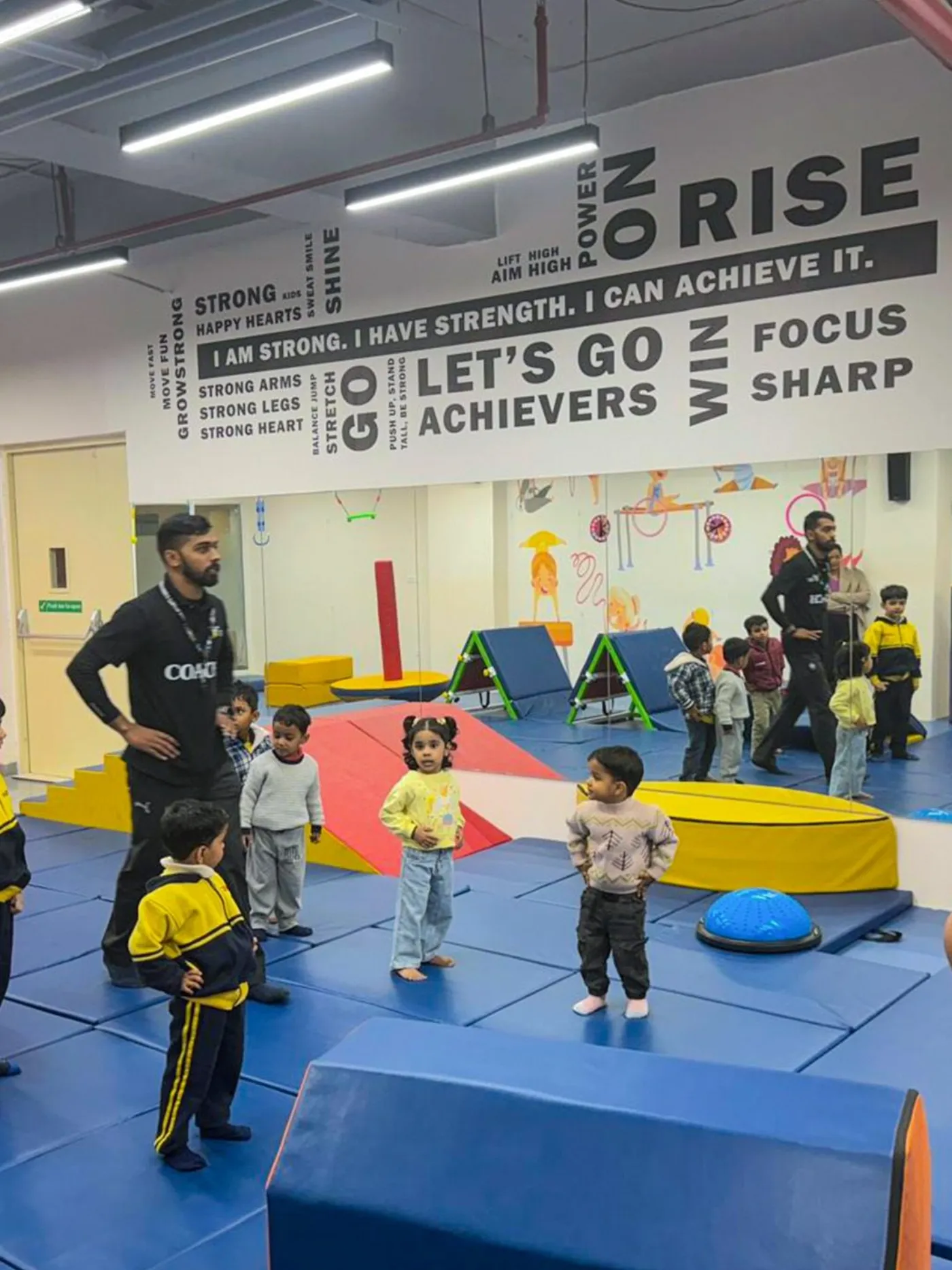
A coach leading a group of young children through a session at GrowStrong Achievers
The 75-minute class

The same five stages, every single week

Children settle faster when they know the shape of the hour. Our class arc never changes — only the theme inside it does.

  1. 1

    Affirmations

    Every class opens with children naming something they are good at. It takes two minutes and it is the part parents most often tell us shows up again at home.

  2. 2

    Social greetings

    A hello circle where each child is greeted by name and greets someone back. Listening, eye contact and taking turns get practised here before any equipment comes out.

  3. 3

    Warm-up

    Movement that lifts the heart rate and opens up flexibility. Nothing demanding happens to a cold body — this is the injury-prevention part of the hour.

  4. 4

    Themed activity

    The week's theme drives the gymnastics drills, the obstacle work and the craft task. Focus comes from the child being interested, not from being told to concentrate.

  5. 5

    Award moment

    A short ceremony recognising effort and improvement rather than winning. Beginners get recognised as readily as the child who already cartwheels.

Five age bands

A four-year-old and a ten-year-old need different things

So they get different classes. Each band has its own drills, its own equipment progressions and its own idea of what a good session looks like.

2–4 years

Little Explorers

A first, gentle introduction to organised physical activity. Toddlers explore movement through play in a safe, friendly space — rolling, climbing, hanging, balancing — while early motor skills and coordination start to form.

  • Parent-reassuring pace, no pressure to perform
  • Soft-play and low apparatus only
  • Focus on confidence with movement itself
4–6 years

Mini Champs

Playful exercises and interactive games where preschoolers develop the essential motor skills school will shortly demand of them. Coordination and real strength begin here, and so does the ability to follow a two-step instruction.

  • Balance, jumping and landing mechanics
  • Fine motor work through the craft element
  • Listening and turn-taking in a group
6–8 years

Skill Builders

A stimulating environment of games and exercises where children sharpen motor skills, learn what teamwork actually feels like, and make friends outside their school circle. Gymnastics shapes get named and practised properly.

  • Named gymnastic shapes and controlled progressions
  • Partner tasks and small-group challenges
  • Reaction games for decision speed
8–10 years

Confident Creators

Strength, coordination and teamwork through activity that stays genuinely fun, while children explore a wider range of gymnastic skills. This is the age where visible mastery starts to feed self-image.

  • Longer skill chains and sequences
  • Core and upper-body strength work
  • Setting and beating a personal target
10–12 years

Future Achievers

A pre-teen programme built around strength, improved coordination and teamwork, delivered through varied activities and games. Keeping this age moving — and off a screen — is half the goal, and they know it.

  • Conditioning that respects growing bodies
  • Leadership moments within the group
  • A reason to stay active into their teens
Not sure?

We place your child on the day

Age is a starting point, not a rule. On a free trial our coaches watch how your child actually moves and how they are socially, then recommend the band that fits — which is sometimes not the one their birthday suggests.

Book a Free Trial
How the curriculum is built

Mapped to real developmental milestones

Our activity-based curriculum is aligned with developmental guidelines from the CDC and the Indian Academy of Pediatrics (IAP), adapted for Indian children.

That matters in a practical way. It means the drills a five-year-old is given are the ones that support what a five-year-old is supposed to be developing — not a scaled-down version of an adult class, and not whatever happened to be fun that week. It also means progress is measured against something real.

  • Gross motor. Running, jumping, climbing, balance — the large movements everything else is built on.
  • Fine motor. Grip, precision and hand–eye coordination, built through the craft element as much as the apparatus.
  • Cognitive. Reaction games and multi-step challenges that train focus, memory and quick decisions.
  • Sensory. Spatial awareness, listening and body position, woven into every drill rather than taught separately.
  • Social-emotional. The greetings, the partner work and the award moment are curriculum, not decoration.

Reference: CDC Developmental Milestones · IAP Guidelines for Parents

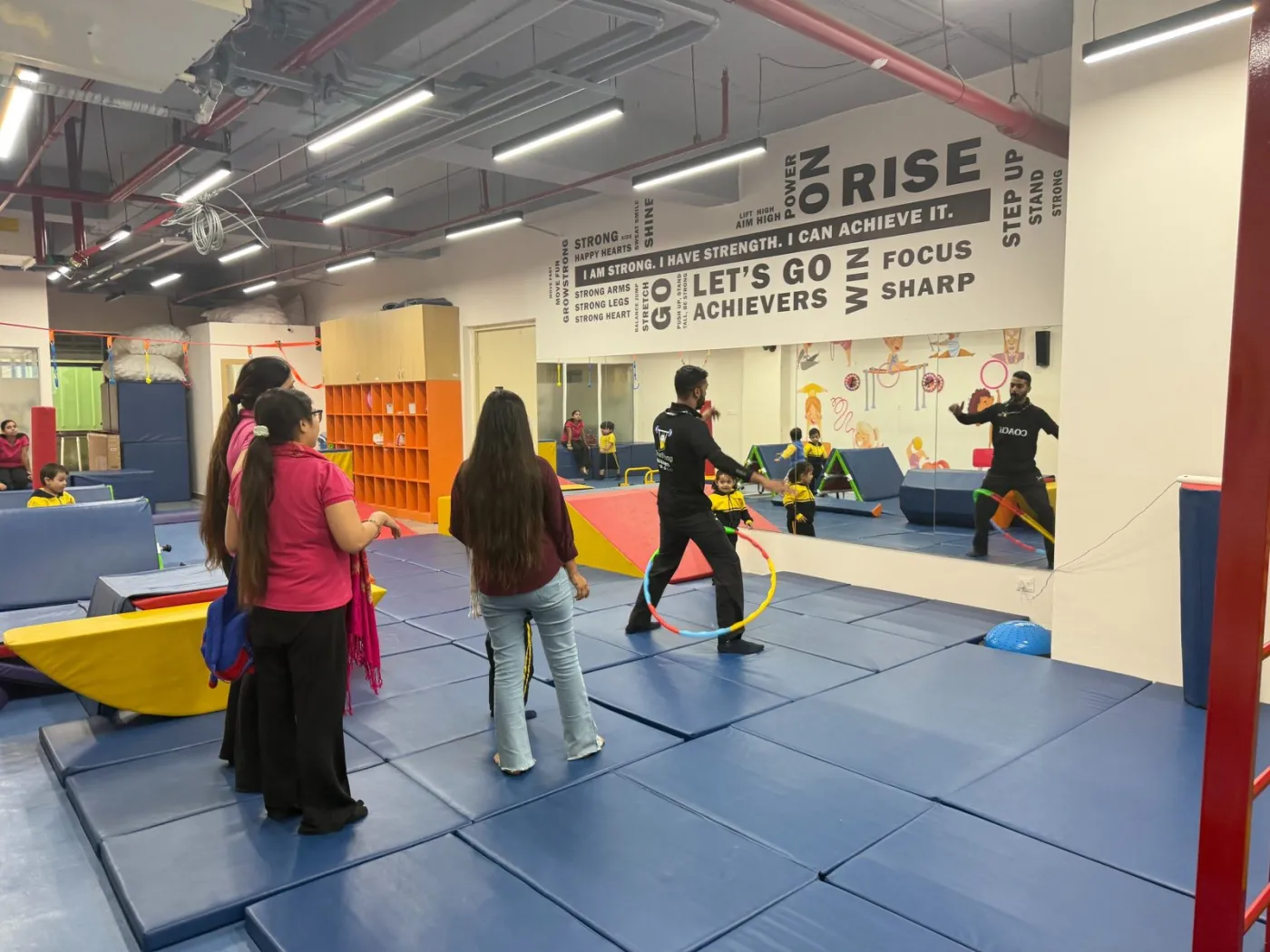
A coach holding a hoop on the gym mats while parents watch from the side
Questions parents ask

Before you book

What age does my child need to be?

Our centre programme runs from age 2 to 12, split across five separate age bands so children always train with peers at a similar stage.

How long is a class?

Each class is 75 minutes and follows the same five-part structure: affirmations, social greetings, warm-up, themed activity and an award moment.

Is my child too shy for a gym class?

No. Sessions are non-competitive and built around encouragement rather than ranking. Quiet children usually settle within the greetings circle, which is designed for exactly that.

Can I watch the class?

Yes. On a free trial we expect you to watch, so you can see the full session before deciding anything.

Do I need to bring anything?

Comfortable clothes your child can move in. Sessions are barefoot on padded flooring, so no special footwear is needed.

What if my child misses a week?

Talk to the centre team on +91 99104 58324 and they will tell you what is possible for your batch.

Where our families come from

Areas we serve

Both centres draw from the neighbourhoods around them. If you are nearby, these pages cover the route, the batches that suit local school timings, and what parents from your area usually ask.

Free trial · No obligation

See a class before you commit to anything

Your child joins a real session. You watch the whole thing. Then you decide — and if it is not right for them, we would rather you knew that on day one.

  • Runs at both centres, 9 AM – 8 PM
  • Five age bands, 2–12 years
  • 75 minutes per class
  • Coaches place your child on the day
Call Book Free Trial