
Daycare, preschool or playschool: what is the difference?
Drive through a residential sector in Greater Noida West or Lucknow and you will probably pass all three words on signboards, sometimes on the same board. They are not interchangeable, and choosing well starts with knowing what each one is actually for.
Short answer: Daycare looks after your child for the hours you need covered, often a full working day. Preschool is a shorter, planned programme of early learning, usually from about three. Playschool is the everyday Indian name for a gentle, play-based preschool session, often a child’s first. Which one fits depends on the hours you need and what your child is ready for.
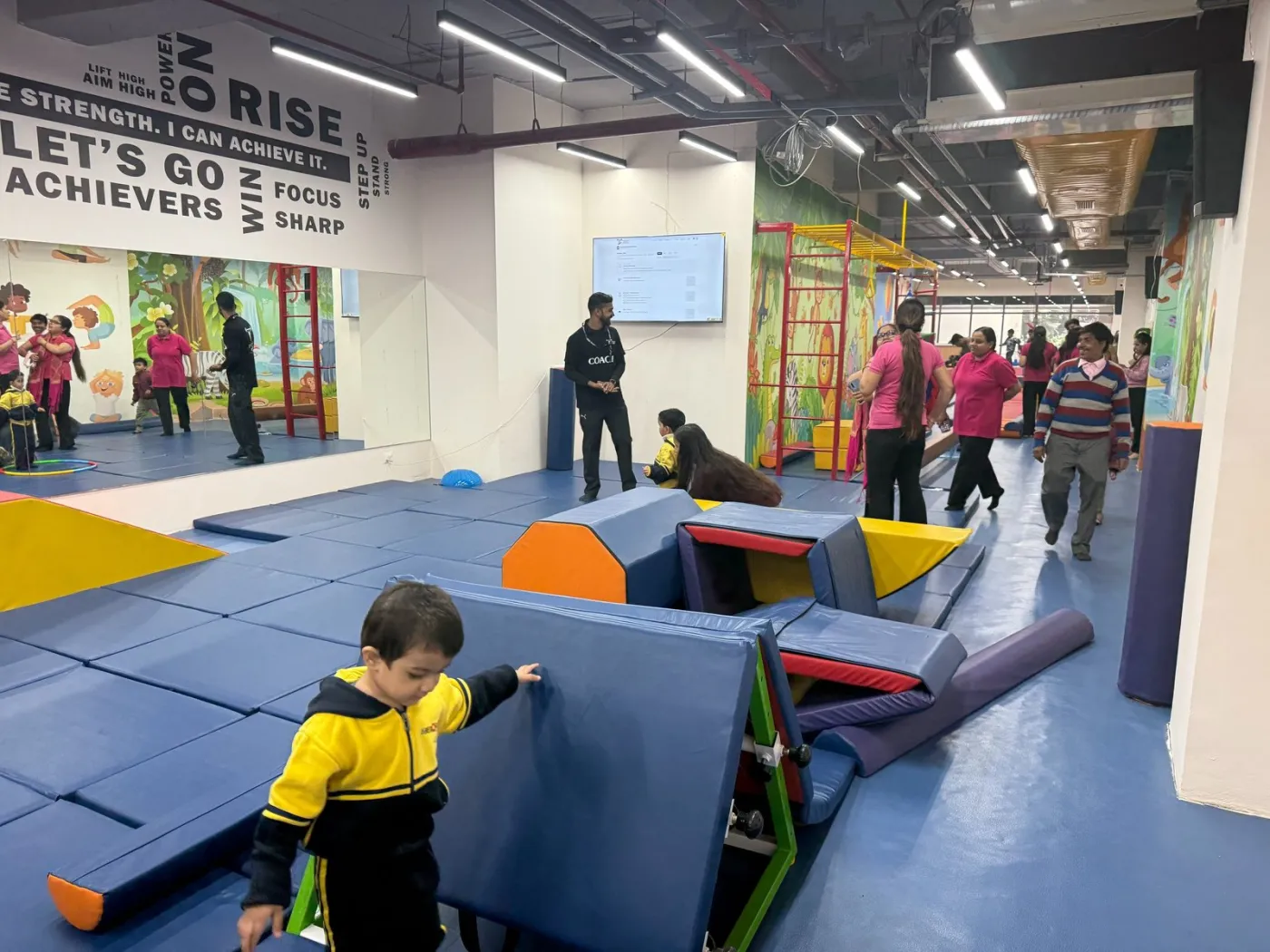
What is the difference between daycare, preschool and playschool?
The difference between daycare, preschool and playschool comes down to purpose: daycare exists to look after your child while you work, preschool exists to prepare your child for school, and playschool exists to give a young child a gentle first experience of a group.
Everything else follows from that. A daycare is organised around your hours, so it has to plan a long day that includes rest. A preschool is organised around a programme of early language, numbers, stories, songs and play, in fixed sessions. A playschool is organised around a child’s first steps away from home, so its sessions are short and its job is to make a group feel safe and interesting.
In practice the lines blur, so look past the signboard and ask two questions: which hours does this cover, and what will my child actually do all day?
| What you are weighing | Daycare | Preschool | Playschool |
|---|---|---|---|
| What it is for | Looking after your child while you work | Early learning and getting ready for school | A gentle first experience of a group |
| Typical ages | Varies widely; some take babies, others begin with toddlers | Roughly three to six, the years national policy calls preschool | Usually the youngest group, often two- and three-year-olds |
| Typical hours | Long and flexible, often matched to a working day | A fixed session of a few hours | Short sessions, often a single morning |
| What a day looks like | Play, rest and routines spread across a longer day | Circle time, stories, early letters and numbers through activities, outdoor play | Free play, songs, stories and simple group games |
| Who it suits | Families who need cover for a full or long working day | Children in the years before Class 1, from about three | A child ready to try a few hours away from home |
| Where it wins | Hours: often the only option that covers a working day | The clearest preparation for school routines | The gentlest start, with short and manageable hours |
| Main limitation | A long day can drift if nobody has planned it | Short hours rarely cover a working parent’s day | Too short to solve childcare; can feel like a stopgap |
Is daycare the same as playschool?
Daycare is not the same as playschool, because a daycare is built around the hours a family needs covered, while a playschool is built around a short session of play-based learning, after which your child goes home.
The confusion is understandable, because the two often share a building and a name: a centre might run a playschool session in the morning and keep some children on for daycare until evening. For your child, though, the hours after the session need their own planning, with rest, quieter play and enough variety that the afternoon does not become waiting for pick-up.
If a centre offers both, ask who stays with the daycare group once the playschool children leave, where they rest, and what fills the time until home. The answer tells you whether the daycare is a real programme or an add-on.
What is a creche, and is it different from daycare?
A creche is a daycare for the youngest children, often including babies, and in India the word is closely tied to childcare at or near a workplace and to childcare run under government schemes.
Two pieces of national policy explain why. The amended Maternity Benefit Act requires every establishment with fifty or more employees to have a creche facility, which is why you will meet the word in office complexes and factories. And the government’s Palna scheme, under Mission Shakti, describes its creches as caring for children from six months to six years, with sleeping facilities, early stimulation for children under three and pre-school education for three- to six-year-olds.
Under the name, a creche and a daycare do the same job; the practical differences are age and location. A workplace creche keeps even a baby close to you during the day, which matters if you are still feeding an infant. A neighbourhood daycare keeps your child close to home instead, so a grandparent or neighbour can collect them when work runs late.
NCERT’s framework for the foundational stage notes that up to the age of three, most children grow up at home and some go to creches, and it says the home should remain almost the sole provider of care and early learning at that age. That is no reason to feel guilty about a creche you need; it is a reason to choose one that feels calm and familiar, with the same few adults every day.
Should my 3-year-old be in daycare or preschool?
Whether your three-year-old should be in daycare or preschool depends mainly on the hours you need covered: if you need care for a working day, choose a daycare that runs a real learning routine, and if you do not, a few hours of preschool is the gentler fit.
Three is the age national policy treats as the start of preschool. Under the National Education Policy 2020, the foundational stage runs from three to eight: three years in a preschool, Anganwadi or Balvatika, then Classes 1 and 2. A three-year-old is not too young for a structured programme, provided it is the kind NCERT’s framework describes, where most learning happens through play, listening and talking rather than worksheets.
The bigger question is how long the day is, and how it is spent. The World Health Organization recommends that three- and four-year-olds get at least 180 minutes a day of varied physical activity, including at least 60 minutes of moderate- to vigorous-intensity activity, and that they are not restrained or left sitting for long stretches. A long day spent mostly at a table or a screen falls well short.
A few practical tests help:
- The journey. A long drive each way in Noida or Lucknow traffic is part of your child’s day too.
- Their stamina. Plenty of three-year-olds still need an afternoon rest, so ask where and when the daycare group rests.
- Goodbyes. A child who finds separation hard often settles faster with a shorter day first.
What is the right age to start a playgroup?
There is no single right age to start a playgroup: playgroups are usually designed for two- and three-year-olds, and whether your child is ready matters more than the date on their birth certificate.
Signs that a child is ready for a few hours in a group tend to look like this:
- They can spend an hour or two with another trusted adult without being upset the whole time; a few tears at the door are normal.
- They are curious about other children, even if they still play beside them rather than with them.
- They can let an adult know when they are hungry, hurt or need the toilet, in words or gestures.
- They can follow a simple routine: arrive, play, tidy up, sit for a song, go home.
Ask each playgroup whether children need to be toilet-trained, because practice varies. If a playgroup still feels like too big a step, a short weekly class can be a gentler halfway point; our guide to classes for two-year-olds looks at the options, and our ideas for helping a shy child join in can be started at home.
If you are unsure whether your child is ready, talk to your child’s paediatrician, who knows their development better than any checklist.

Which comes first: pre-nursery, nursery, LKG or UKG?
The usual order is pre-nursery or playgroup, then nursery, then LKG, then UKG, and then Class 1, although schools name and count these years differently.
- Pre-nursery or playgroup: the youngest class, where a school has one.
- Nursery: often the first year of a school’s pre-primary section.
- LKG, or lower kindergarten.
- UKG, or upper kindergarten: the year before Class 1, the preparatory year that national policy calls Balvatika.
- Class 1, which national policy says children should begin at six.
That ladder can have more rungs than the policy, which counts three years of preschool, from three to six, before Class 1. When a school also runs a pre-nursery or playgroup for two-year-olds, that year comes first.
The names are where parents get caught out. Some schools have no class called nursery at all and use the word for the whole pre-primary stage; others begin with a pre-nursery class for children of the age another school places in LKG. Compare schools by their published age rules, never by the name of the class. Our nursery admission guide for 2027-28 in Noida and Lucknow works through two published examples.
What are the red flags to watch for in a daycare?
The biggest red flag in a daycare is a centre that would rather show you an empty room than let you see it while children are there; after that, watch for vague answers about who looks after your child and for children who seem bored, parked or ignored.
You do not need any training to spot the rest. Visit at an ordinary time of day, stay longer than the tour, and watch the children more than the walls.
- Nobody can say who will be with your child. You should be able to find out who looks after the group each day, and how many adults are with how many children.
- The faces keep changing. Young children settle with familiar adults.
- Children sit for long stretches or watch screens. Long, passive stretches usually mean nobody has planned the day.
- Nobody can describe a typical day, including when children rest.
- Collection rules are loose. A centre should ask who may collect your child, and check every time.
- Safety and hygiene look neglected: unguarded stairs or windows, exposed sockets, exits left open, or toilets you would not use yourself.
- You are pushed to pay on the spot. A confident centre expects you to think it over.
One last test comes after you start. Many children take days or a few weeks to settle; a child who is still distressed every morning after that, or who becomes withdrawn at home, deserves a frank conversation with the centre.
Can one programme be both a preschool and a daycare?
One programme can be both a preschool and a daycare, as long as the whole day is planned for the child rather than split into a morning of learning and an afternoon of waiting.
In a well-run combined programme, the longer hours add what a short session cannot: more active play, more time with the same children, and proper rest. In a poorly run one, the learning stops at midday and the rest is supervision, so ask to see the afternoon as well as the morning.
This is where our own programme fits. Achievers Care is the preschool and daycare programme at both GrowStrong Achievers centres, in Greater Noida West and Lucknow. It runs inside our kids’ gym, with the same coaching team that takes our gymnastics classes, so physical activity, motor-skill development and social-emotional learning are built into the day, with calm rest periods in between.
It will not suit every family. If you want a formal, academic pre-primary, or want your child settled early in the school they will stay at, a school’s own pre-primary section may serve you better. We have no tie-ups with any school and cannot promise anyone an admission. The fairest way to judge Achievers Care is to visit while a session is running, which we encourage, or to start smaller with a free trial class in our weekly programme.
Sources
- National Curriculum Framework for Foundational Stage 2022 — NCERT, 2022
- Palna Scheme under Mission Shakti — Government of NCT of Delhi, reproducing the Ministry of Women and Child Development’s Mission Shakti guidelines, 2022
- To grow up healthy, children need to sit less and play more — World Health Organization, 2019
- The Right of Children to Free and Compulsory Education Act, 2009 — Gazette of India copy, published on the Government of Uttar Pradesh RTE portal
Questions parents ask
Will my child fall behind in daycare rather than preschool?
Going to daycare rather than preschool does not by itself put a child behind; what matters is whether the day is full of conversation, stories, play with other children and movement. NCERT's framework for this age says most learning happens through play, listening and talking. A daycare that does those things well gives a young child much of what a preschool would, so ask what a typical week actually includes.
Does my child have to go to preschool before Class 1?
Preschool sits outside the compulsory years in India: the Right to Education Act gives every child from six to fourteen the right to free and compulsory education. National policy does say children should be in a preschool or Anganwadi from three to six, and NCERT's framework reports that only about half of the children who entered Grade 1 in 2020-21 had any preschool experience. Schools set their own entry rules, so check the class yours admits into.
Is a year of playschool worth it before nursery?
A year of playschool is worth it when it gives your child a happy, gentle start in a group, but it is a choice rather than a step every child must take. A child who spends that year playing at home, outdoors and with other children is not behind. What playschool adds is practice at the things nursery asks for: saying goodbye at the door, following a routine and sitting for a story.
Can my child go to preschool in the morning and daycare in the afternoon?
Many families combine a morning preschool with an afternoon daycare, and it works well when the handover is reliable and the day is not too long for the child. Two settings mean two groups of adults, two sets of rules and often a journey in between, which adds up for a three-year-old. Keep the routine the same every day, and make sure the afternoon includes proper rest.
Do we need daycare if a grandparent looks after our child?
You do not need daycare if a grandparent can care for your child happily and safely at home; loving family care is a good start in life. What a group adds is time with other children and with adults outside the family. Many families add that through a few hours of preschool, or a weekly class alongside grandparent care, such as our age-banded gym classes.
Should we choose a daycare near home or near work?
Choose whichever location keeps your child's day shortest and lets one of you reach them quickly. Government creche guidance prefers a site within walking distance of the child's home or the mother's workplace, partly so that a mother can come in to feed a baby. A daycare near home suits families where a grandparent does pick-up; one near work suits a parent who wants to be close during the day.