Classes for 2-year-olds: what is worth doing at two
Two is an age of enormous energy and very short attention, which makes choosing a class surprisingly hard. The right class at this age looks more like guided play than a lesson, and it fits around naps rather than the other way round.
Short answer: A two-year-old is ready for short, play-based classes rather than formal lessons: toddler gym or movement classes, music and rhythm groups, parent-and-child swimming, or a playgroup. Look for soft, low equipment, simple instructions, plenty of variety and no pressure to perform. Expect your child to spend part of any class watching; at two, that is part of learning.
What classes can a 2-year-old take?
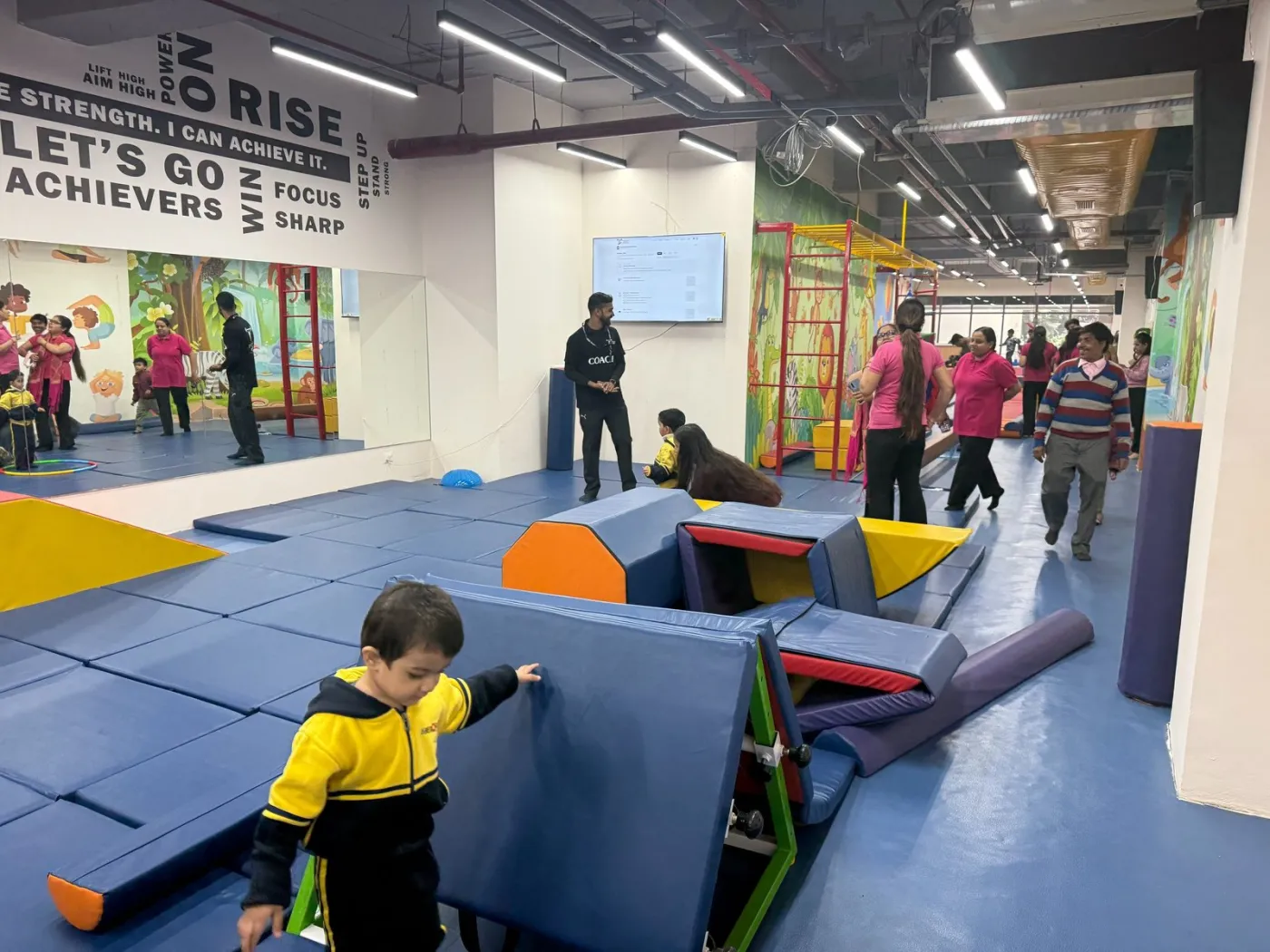
A two-year-old can take short, play-based classes such as toddler gym or movement sessions, music and rhythm groups, parent-and-child swimming and playgroups. The activity matters less than how the class is run.
The good ones have a few things in common. They let a toddler move, make noise and wander off for a moment without anyone treating it as a problem. They are built from short bursts of something new rather than one long task. And they give your child a first taste of following a friendly adult who is not you, alongside other children.
What does not suit a two-year-old is anything that expects them to sit still for long, queue for a turn, or repeat one skill until it is right. That is not a question of ability. It is simply not how children of this age learn.
Preschool and daycare are a different decision. They are about a daily routine, early learning and time away from home, and many families combine one with a weekly activity class. If you are weighing those options, our guide to daycare, preschool and playschool explains how they differ.
What should a 2-year-old be able to do physically?
By their second birthday, most children can run, kick a ball, walk up a few stairs with or without help, and eat with a spoon, according to the CDC's milestone checklist. Those four are the movement milestones the CDC lists at two.
The same checklist includes a few things that matter in a class. Most two-year-olds can hold something in one hand while using the other, such as holding a container and taking the lid off. Most also look at your face to see how to react in a new situation. That second one is worth remembering on a first visit: a calm parent watching from the side tells a toddler the room is safe.
It helps to see two as a point on a line. By 18 months, the CDC lists walking without holding on and climbing on and off a couch or chair without help. By 30 months, it lists jumping off the ground with both feet and following two-step instructions such as “Put the toy down and close the door.” A good toddler class gives children room to practise exactly these things, at their own pace. For how big-muscle and small-muscle skills develop side by side, see our guide to gross and fine motor skills.
Children reach these points at different times, and a milestone is not a race. But the CDC's advice is clear: if your child is not meeting one or more milestones, has lost skills they once had, or you have other concerns, do not wait. Talk to your child's paediatrician and ask about developmental screening.
Is a 2-year-old too young for gymnastics?
A two-year-old is not too young for a gentle, play-based movement class built for toddlers, but is too young for gymnastics as a sport. The distinction matters.
The American Academy of Pediatrics suggests waiting until about age six for organised sports. It also says younger children should enjoy free play every day to help their bones, muscles and balance develop, without pressure to perform. Formal training — set routines, repetition for neatness, scores — has no place at two.
A toddler class done well sits much closer to the second half of that advice. It is play with a little structure around it: soft shapes to climb, low beams to walk along, things to roll over and crawl through, and an adult who makes it all feel like a game. Rolling, climbing, hanging and balancing are the movements a two-year-old's body is ready to explore.
How gymnastics changes as children grow, from these first explorations to named skills at seven or eight, is a separate question, and we cover it in what age a child should start gymnastics.
What happens in a toddler gym class?
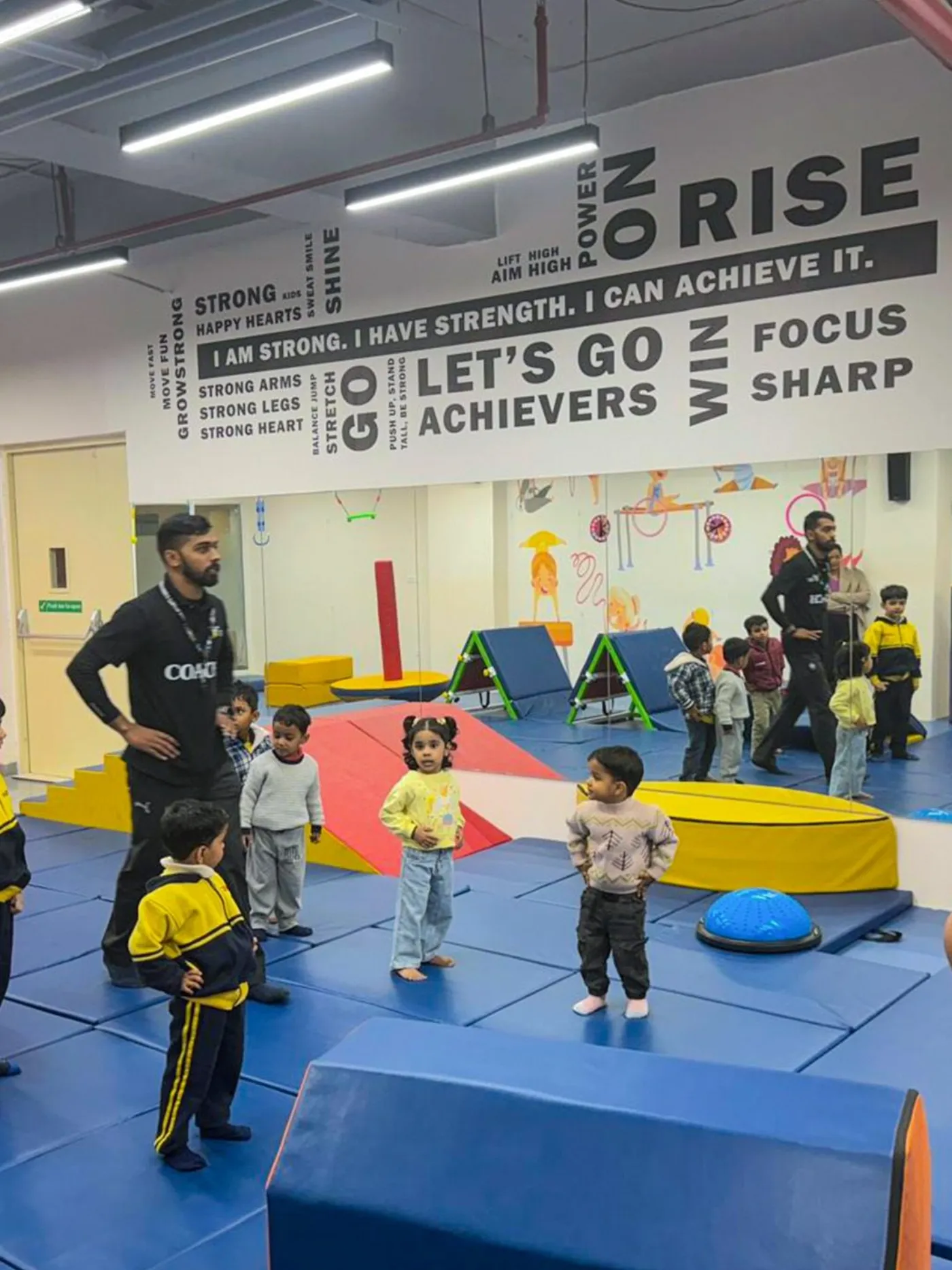
In our toddler gym class, Little Explorers, children aged two to four explore movement through play on soft-play and low apparatus, with no pressure to perform. It is deliberately gentle: a first introduction to organised physical activity rather than training.
Like every class in our Centre Programme, it lasts 75 minutes and follows the same five stages each week:
- Affirmations — children name something they are good at.
- Social greetings — a hello circle.
- Warm-up — movement that gets small bodies ready before anything else happens.
- Themed activity — the week's theme shapes the gymnastics play, obstacle work and craft task, all at toddler level on soft-play and low apparatus.
- Award moment — recognising effort and improvement, not winning.
Seventy-five minutes sounds long for a two-year-old, and it would be if it were spent on one thing. The five stages change the activity often, and with no pressure to perform, a toddler who stops to watch for a while is not falling behind. Because the order never changes, the routine itself becomes familiar, which matters at an age that runs on routine.
The craft task does quiet work too, because the hand control it asks for is the same control a child will later need to hold a crayon.
You can watch. On a free trial we expect you to stay for the whole session, so you see exactly what your child does and how the coaches respond. Once your child has started, ask the centre team how watching works for the youngest band.
How do I choose the right class for my toddler?
Choose a toddler class by watching one first: the right class is playful, unhurried and run by adults who are comfortable letting a two-year-old be two.
The American Academy of Pediatrics has argued for a balanced early-childhood curriculum that includes playful learning, noting that early childhood programmes are under pressure to add more instruction and less play. That is a useful lens for any toddler class. Things worth looking for:
- Play first. Children should be moving, laughing and choosing, not standing in lines.
- Equipment sized for toddlers. Padded floors, soft shapes and low apparatus, with nothing a two-year-old could fall far from.
- Simple, warm instructions. One step at a time, shown as much as said.
- No pressure to perform. A child who watches for half the class is welcomed back next week, not singled out.
- A predictable routine. The same shape every week helps toddlers settle.
- A trial before you commit. You should be able to see a full session first.
Practical details matter as much as the programme. A class that clashes with nap time is likely to go badly however good it is, and a long drive through evening traffic can use up a toddler's patience before you arrive. Once a week is plenty at this age, and our guide to how many times a week children should do gymnastics explains why the rest of the week matters more.
If you also need childcare, Achievers Care, our preschool and daycare programme, runs inside both centres with the same coaching team, and builds physical activity and motor-skill work into the day. Talk to us about your child's age, because placement depends on the group running at your centre.
The simplest test is a free trial class. Watch how the coaches speak to the youngest children, how they handle a toddler who wanders off, and whether your child wants to go back.
What can I do at home to help a 2-year-old move well?
At home, the most useful thing you can do for a two-year-old's movement is offer lots of short, varied chances to be active through the day. The WHO recommends that children aged one and two spend at least 180 minutes a day in a variety of physical activities, at any intensity, spread across the day. It also advises that they are not restrained for more than an hour at a time in a pram, high chair or carrier.
Three hours sounds a lot until you notice it is made of minutes: a walk to the lift, a dance in the kitchen, a chase around the sofa. A few ideas that follow the milestones above:
- Kick and roll a ball along a corridor or across the society park, taking turns.
- Stairs with a hand to hold. Walking up a few steps side by side is a milestone in itself.
- A cushion obstacle course on the floor: over, under, through and round.
- Jumping practice on flat ground with both feet together, then off the lowest step with you holding a hand.
- Music and movement: stamping, swaying and freezing when the music stops.
- Busy hands: scooping sand in a sandpit, and putting lids on and off plastic containers.
Indoor space matters in a high-rise. Summer heat and monsoon weeks can keep a toddler inside for days, so clear a patch of floor where climbing, rolling and tumbling are allowed. Keep it low, supervise closely and let them fall onto something soft; tumbling is part of learning to move.
None of this needs equipment or a plan. What helps most is a parent who joins in sometimes, praises trying rather than succeeding, and accepts that a two-year-old's attention moves on after a few minutes.
Sources
- Milestones by 2 Years — Centers for Disease Control and Prevention, 2026
- Milestones by 18 Months — Centers for Disease Control and Prevention, 2026
- Milestones by 30 Months — Centers for Disease Control and Prevention, 2026
- To grow up healthy, children need to sit less and play more — World Health Organization, 2019
- Burnout in Young Athletes: How to Keep the Fun in Sports — American Academy of Pediatrics, HealthyChildren.org, 2024
- The Power of Play: A Pediatric Role in Enhancing Development in Young Children — Yogman et al., American Academy of Pediatrics, Pediatrics, 2018
Questions parents ask
Does my toddler need to be walking well before joining a class?
Walking on their own is the main physical starting point for a toddler movement class, and the CDC lists it among the things most children do by 18 months. Your child does not need to be steady or quick; wobbles and tumbles are expected at two. If your child is two and not yet walking without holding on, talk to your paediatrician before booking any class.
What time of day suits a class for a 2-year-old?
The right time for a toddler class is when your child is rested and fed, which for many two-year-olds means after a nap rather than just before one. The WHO recommends 11 to 14 hours of good-quality sleep a day at this age, naps included, so plan the class around sleep, not the other way round. Both our centres are open 9 AM to 8 PM every day, so ask which batches fit your routine.
What can a toddler class offer that the society park cannot?
A toddler class offers equipment sized for a two-year-old, a predictable routine and the experience of following a friendly adult in a group, which a park rarely offers all at once. The park still matters: it is where your child plays freely, ideally every day. A weekly class adds structure and variety on top of that; it does not replace the slide and the sandpit.
My 2-year-old falls over a lot. Is that normal?
Frequent tumbles are a normal part of being two, because toddlers are still learning to run, stop, turn and judge distances. Getting up again is part of how balance develops, so give them soft, safe places to practise. Talk to your paediatrician if the falling seems to be getting worse rather than better, or if your child has lost a skill they used to have.
How will I know if my toddler is enjoying their class?
You will usually know a toddler is enjoying a class from what happens afterwards rather than during it. Look for a child who mentions it, copies moves at home, recognises the building or asks to go. During the class, watching from the edge is normal at first. If your child is still upset every time after several weeks, talk to the coaches, because a different time or a short break can help.