Gross motor vs fine motor skills, and why your child needs both
These two phrases turn up on many children's activity websites, rarely with an explanation. Here is what they mean, what is typical around age three, and why treating them separately is a mistake.
Short answer: Gross motor skills are the big movements that use the large muscles of the body: running, jumping, climbing and balancing. Fine motor skills are the small, precise movements of the hands and fingers: holding a crayon, threading a bead, doing up a button. They develop side by side, and a steady body is part of what makes a steady hand possible.
What is the difference between gross and fine motor skills?
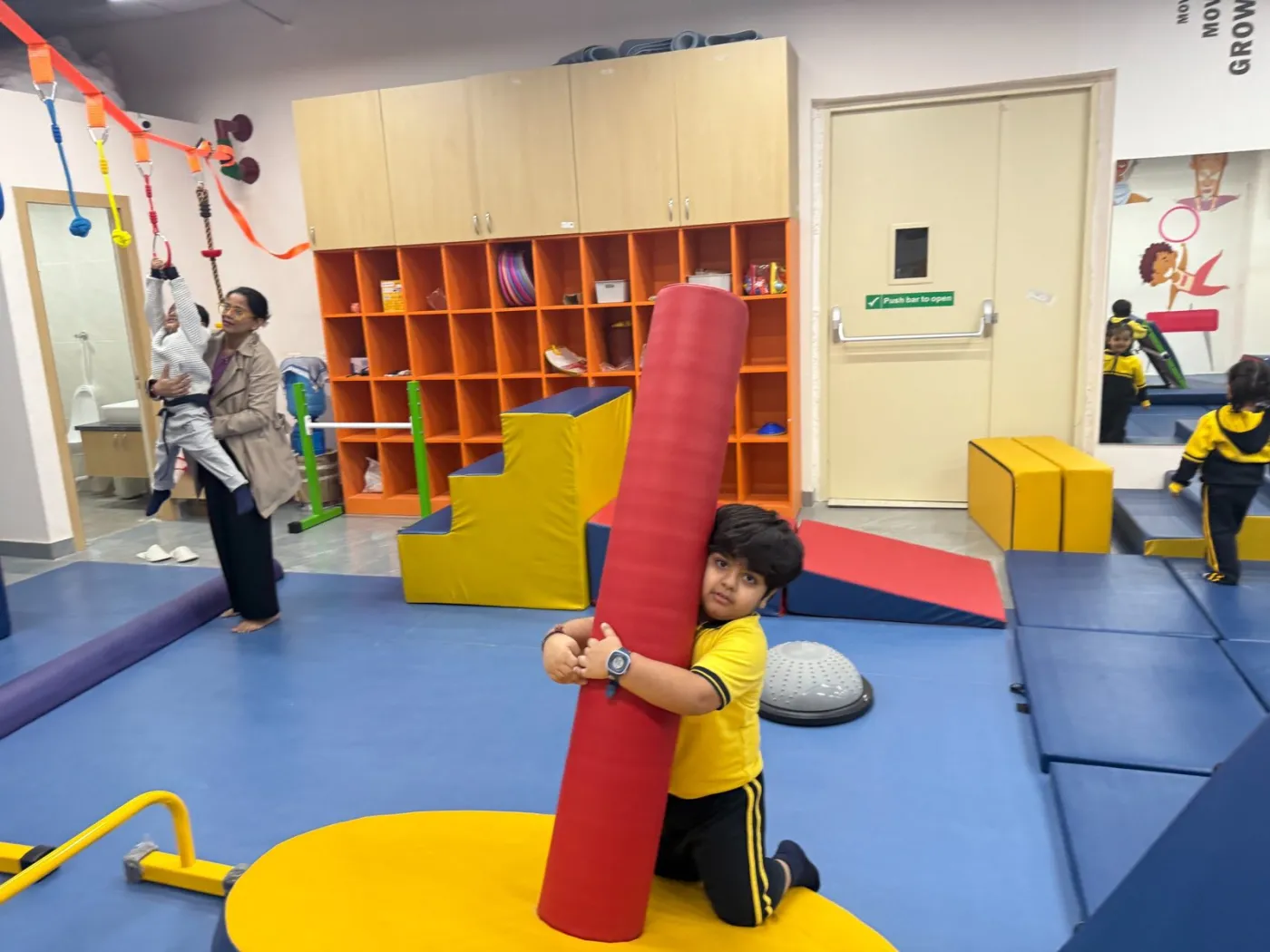
Gross motor skills are whole-body movements that use the large muscles, while fine motor skills are precise movements of the hands and fingers that use the small ones. Running, jumping, climbing, balancing, throwing and catching are all gross motor skills.
Fine motor skills are quieter and easier to overlook: gripping a pencil, turning a page, using scissors, doing up a button. They depend on finger and wrist control and on hand–eye coordination, which matters as much for catching a ball as for colouring inside the lines.
How are gross and fine motor skills connected?
Gross and fine motor skills are connected because the hand can only be as steady as the body holding it up. A child who cannot keep their trunk stable while sitting at a table is trying to do precision work from a wobbly base, and the pencil shows it.
This is why “more writing practice” so often fails to fix messy or tiring handwriting. The difficulty is not always in the hand. Core strength, shoulder stability and the ability to hold a posture sit underneath every line a child writes, and they are built by climbing, hanging, crawling, pushing and carrying — not by another page of tracing.
What gross motor skills should a 3-year-old have?
By three, most children can run, kick a ball, walk up a few stairs and jump off the ground with both feet, according to the CDC's developmental milestone checklists. The CDC defines a milestone as something most children (75% or more) can do by a certain age, so each one is a checkpoint rather than an average.
Around age three, the checklists line up like this:
- By 2 years: kicks a ball, runs, and walks (not climbs) up a few stairs, with or without help
- By 30 months: jumps off the ground with both feet
- By 4 years: catches a large ball most of the time
- By 5 years: hops on one foot
So a three-year-old who cannot yet catch reliably or hop has not missed anything on those lists. The CDC's movement checklist for age three is, in fact, all hand and self-care skills.
What fine motor skills should a 3-year-old have?
By three, most children can string large beads or macaroni together, put on some loose clothes by themselves and use a fork, according to the CDC. Its three-year checklist also includes drawing a circle when you show them how.
By four, the CDC adds unbuttoning some buttons, pouring water or serving food with an adult supervising, and holding a crayon or pencil between the fingers and thumb rather than in a fist. By five, it adds buttoning some buttons.
These skills happen at the dining table and while getting dressed. In many busy households it is quicker for a parent, grandparent or helper to feed and dress a three-year-old, especially on a school morning, but handing back even one of those jobs, on days you can spare ten minutes, is worth more than a new set of activity books.
How can I improve my child's balance and coordination at home?
You can improve your child's balance and coordination at home with short, playful games that ask the body to do something slightly new, repeated little and often. A child will hang from a bar fifty times if it is a game and twice if it is an exercise, so make it a game.
- Tape-line beam. A strip of masking tape on the floor becomes a beam: walk it forwards, sideways, then backwards.
- Stepping stones. Cushions spread across the floor become stones over a river. Move them further apart as your child gets steadier.
- Animal walks. Bear crawls, crab walks and frog jumps build shoulder and core strength along with coordination.
- Balloon keepy-uppy. Keep a balloon in the air with hands, then elbows; it floats slowly enough for a young child to track.
- Catch with socks. Rolled-up socks are easier to catch than a ball; start close and step back as the catches improve.
Keep the floor clear and soft, away from glass tables, sharp corners and balcony doors, and stop while it is still fun. Outdoors, hopscotch chalked in the society park does the same job. On days when the air keeps everyone inside, indoor games matter more, and our guide on whether children should play outside during pollution covers how to decide.
What activities improve fine motor skills in preschoolers?
Activities that make the small muscles of the hand work against a little resistance, or with a little precision, improve fine motor skills in preschoolers. Try these:
- Play dough: rolling, squeezing, pinching, and cutting it with a blunt knife
- Tearing paper into strips for a collage, then sticking the pieces down
- Threading large beads onto a shoelace
- Clipping clothes pegs around the rim of a box or bucket
- Pouring water between cups at bath time
- Helping in the kitchen: tearing spinach leaves, or kneading and rolling a small ball of atta
Give big movements equal time too: hanging from a bar, crawling through a tunnel of chairs and pushing a laundry basket strengthen the shoulders and trunk a steady hand depends on.
What helps least is drilling: page after page of tracing for a child whose grip tires after three lines. Short, frequent and playful does more than long and dutiful.
When should I worry about my child's motor skills?
You should talk to your child's paediatrician if your child is not meeting one or more milestones for their age, has lost skills they once had, or if something about how they move simply worries you. That is the CDC's own advice: act early, share your concerns with your child's doctor and ask about developmental screening, rather than waiting to see.
Children develop at different rates, and none of these signs is a diagnosis, but each is worth mentioning at the next check-up:
- Avoiding climbing frames, or coming down as soon as they are up
- Tiring much faster than other children during active play
- Bumping into furniture and people often, as if unsure where their body is
- Still finding buttons, zips or a spoon very hard long after friends of the same age manage them
- Gripping a pencil very hard, or tiring after a few lines of writing
- Reluctance to join physical games, often explained as “not interested” when it is closer to “not confident”
That last one deserves attention even when everything else is fine, because a child who decides early that they are “not sporty” tends to stop practising; our article on why gymnastics builds confidence in kids explains how that belief forms. If your worry is more about how little your child moves in a week, start with how to tell whether your child is active enough.
Is gymnastics good for motor skills?
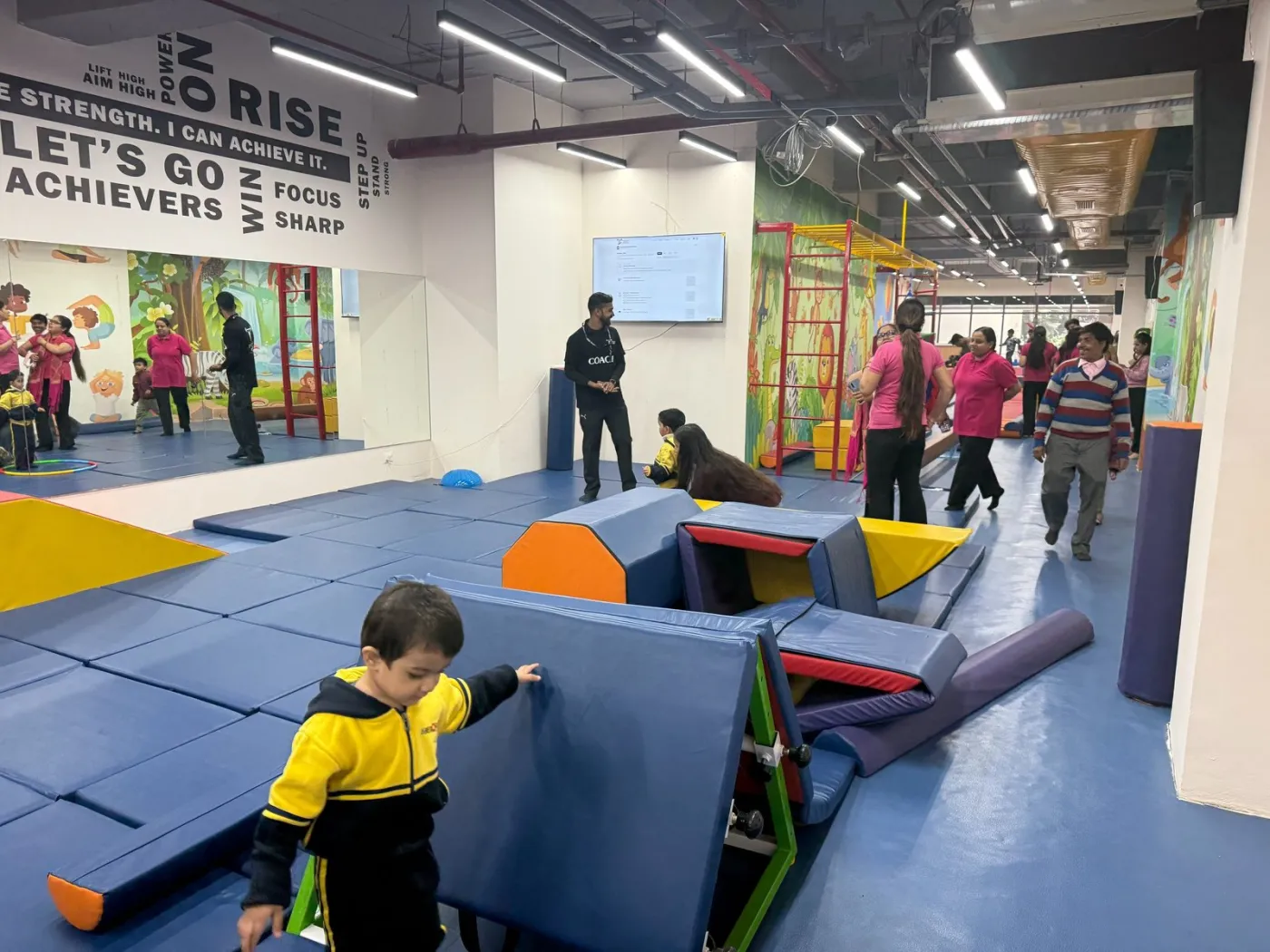
Gymnastics is good for motor skills because it works the big movements and the small, precise ones in the same session, in a form children are happy to repeat. Climbing, hanging, rolling and balancing on a low beam build core strength, balance and body awareness, while gripping a bar and landing safely demand control.
At GrowStrong, our Centre Programme is a 75-minute class, attended once or more a week, in one of five age bands. The curriculum is aligned to CDC and Indian Academy of Pediatrics (IAP) guidelines, and each class deliberately covers gross motor, fine motor, cognitive, sensory and social-emotional development. The themed activity mixes gymnastics drills, obstacle work and a craft task, so the climbing and the careful hand work happen in the same hour.
Little Explorers (ages 2–4) introduces toddlers to movement on soft-play and low apparatus, with no pressure to perform; our guide to classes for 2-year-olds covers that age in more detail. Mini Champs (ages 4–6) builds balance, jumping and landing, which school will soon ask of them, and practises following a two-step instruction.
If any of this sounded familiar, book a free trial class: you can watch the whole session, and the coaches will tell you honestly what they notice about how your child moves.
Sources
- Milestones by 2 Years — CDC, Learn the Signs. Act Early., 2026
- Milestones by 30 Months — CDC, Learn the Signs. Act Early., 2026
- Milestones by 3 Years — CDC, Learn the Signs. Act Early., 2026
- Milestones by 4 Years — CDC, Learn the Signs. Act Early., 2026
- Milestones by 5 Years — CDC, Learn the Signs. Act Early., 2026
Questions parents ask
What does body awareness mean in a young child?
Body awareness is a child's sense of where their arms, legs and trunk are, and how much force they are using, without needing to look. It comes from signals in the muscles and joints, and it grows with movement that loads them: climbing, crawling, hanging, pushing and carrying. A child who is still building it may bump into things, press very hard with a crayon or find it tricky to sit still on a chair.
Can a child be ahead in fine motor skills but behind in gross motor skills?
A child can easily be ahead in one area and behind in the other, because the two develop at their own pace and depend partly on what the child chooses to practise. A child who loves drawing may avoid the climbing frame, and a fearless climber may dread buttons. The aim is to nudge the weaker side along through play, not to turn it into a project.
Can an older child still catch up on coordination?
An older child can still improve their coordination, because motor skills keep responding to practice well beyond the preschool years. What often changes with age is not the ability to learn but the willingness to be seen learning, since a nine-year-old notices who is watching. Regular, low-pressure practice among children of a similar age helps. If you are worried about how far behind your child seems, ask their paediatrician.
Which everyday chores help a child's motor skills?
Everyday chores help motor skills whenever they ask a child to carry, pour, grip or balance something with care. Carrying a light bag of shopping, laying spoons on the table, folding small towels, watering plants and wringing out a cloth all count. They also show a child that their hands are genuinely useful at home, and children who feel useful tend to volunteer for more.
Should I correct the way my child holds a pencil?
Gently showing your child a comfortable grip occasionally is fine, but correcting it every few minutes tends to turn drawing into a test. The CDC lists holding a crayon between the fingers and thumb, rather than in a fist, among the things most children do by four, so a younger child's fist grip is not, on its own, a cause for alarm. Play dough, pegs and climbing build the strength a mature grip needs. If writing is painful or tiring at school age, mention it to your paediatrician.