“They run around at school” — is that enough?
Most parents assume the school covers it. Some schools do. But the arithmetic is worth doing honestly, because the gap is usually larger than it feels.
Short answer: WHO's benchmark for children aged 5 to 17 is an average of at least 60 minutes a day of activity that leaves them breathing harder, and for three- and four-year-olds at least three hours a day of varied activity. A PE period or two and a short evening in the park often fall well short, and the gap is usually in strength, balance and coordination.
Is school PE enough exercise for my child?
School PE on its own is rarely enough exercise, because one or two periods a week cannot add up to an average of an hour of activity every day.
Take a normal week. How many periods of genuine physical activity does your child get at school — not assembly, not a games period that became a revision period, but time actually moving? For many children in urban India the honest answer is one or two, of perhaps forty minutes, of which a good portion is queuing, changing and being organised.
Now add whatever happens at home. In a high-rise, that is often a society park for a while in the evening, weather, air and homework permitting, with more standing and talking than moving as children get older. Set against an hour a day, it adds up to considerably less than it feels like from the outside.
How do I know if my child is active enough?
The surest way to know whether your child is active enough is to log one ordinary week and set it against WHO's guidance of roughly an hour of moderate-to-vigorous activity a day for children of school age.
That hour is an average across the week, mostly aerobic, for children aged 5 to 17. Three- and four-year-olds are counted differently: at least 180 minutes of varied activity spread through the day, of which at least an hour should be the livelier kind.
“Moderate” means more than pottering about. The NHS describes it as activity that raises the heart rate and makes a child breathe faster and feel warmer, and offers a simple test: if they can still talk but not sing, they are there. Vigorous is harder again — the chasing, racing and jumping that leaves them breathing hard and fast.
For the log, write down each day's PE, park time, walks, cycling, classes and active play, with an honest estimate of minutes, and leave out the time spent standing around. Then look at three things:
- The total. Does it come to roughly an hour a day on average for a school-age child, or about three hours of varied movement for a three- or four-year-old?
- The mix. Is there anything that builds strength, such as climbing, hanging or jumping, as well as running about?
- The sitting. How long are the longest stretches of sitting, and how much of that time goes on recreational screens?
Whatever the result, you are now working from a record rather than a feeling, and you know which of the three needs attention first.
Does running around in the park count as exercise?
Running around in the park does count as exercise, but on its own it rarely builds the strength, balance and coordination a child also needs.
Unstructured running around maintains fitness. It does not necessarily build capability. A child left to their own devices in a park will do the things they are already comfortable with and avoid the things they are not. The child who finds climbing hard will simply not climb. Free play, left alone, tends to reinforce a child's existing strengths and quietly consolidate their avoidances.
Structured sessions do the opposite. A coach notices what a child avoids and builds a gentle path into it, which is exactly what unstructured play cannot do. Free play still matters enormously, for imagination and friendships as much as fitness; the point is that it works better alongside something structured than instead of it.
What are the signs a child needs more movement?
The clearest signs a child needs more movement are reluctance to try physical things, tiring faster than friends, and choosing to sit almost every time there is a choice.
- Reluctance to try physical things in front of others, framed as boredom
- Getting out of breath much faster than other children of the same age
- Preferring seated activities almost every time a choice is offered
- Complaints of aches after mild activity
- Trouble settling to sleep despite seeming tired
- The phrase “I am not good at sports” appearing before age eight
That last one is the one to take most seriously. It is rarely a statement of fact. It is usually a conclusion a child has drawn from a small number of experiences, and once drawn it becomes self-fulfilling for years.
None of these signs is a diagnosis. If your child gets breathless unusually quickly, complains of pain, or seems tired all the time, mention it to your paediatrician, who can check whether anything else is going on.
What kind of activity does my child need?
Your child needs a mix of activity rather than more of one kind: something that gets them out of breath, something that builds strength, something that challenges balance and coordination, and ideally some of it with other children.
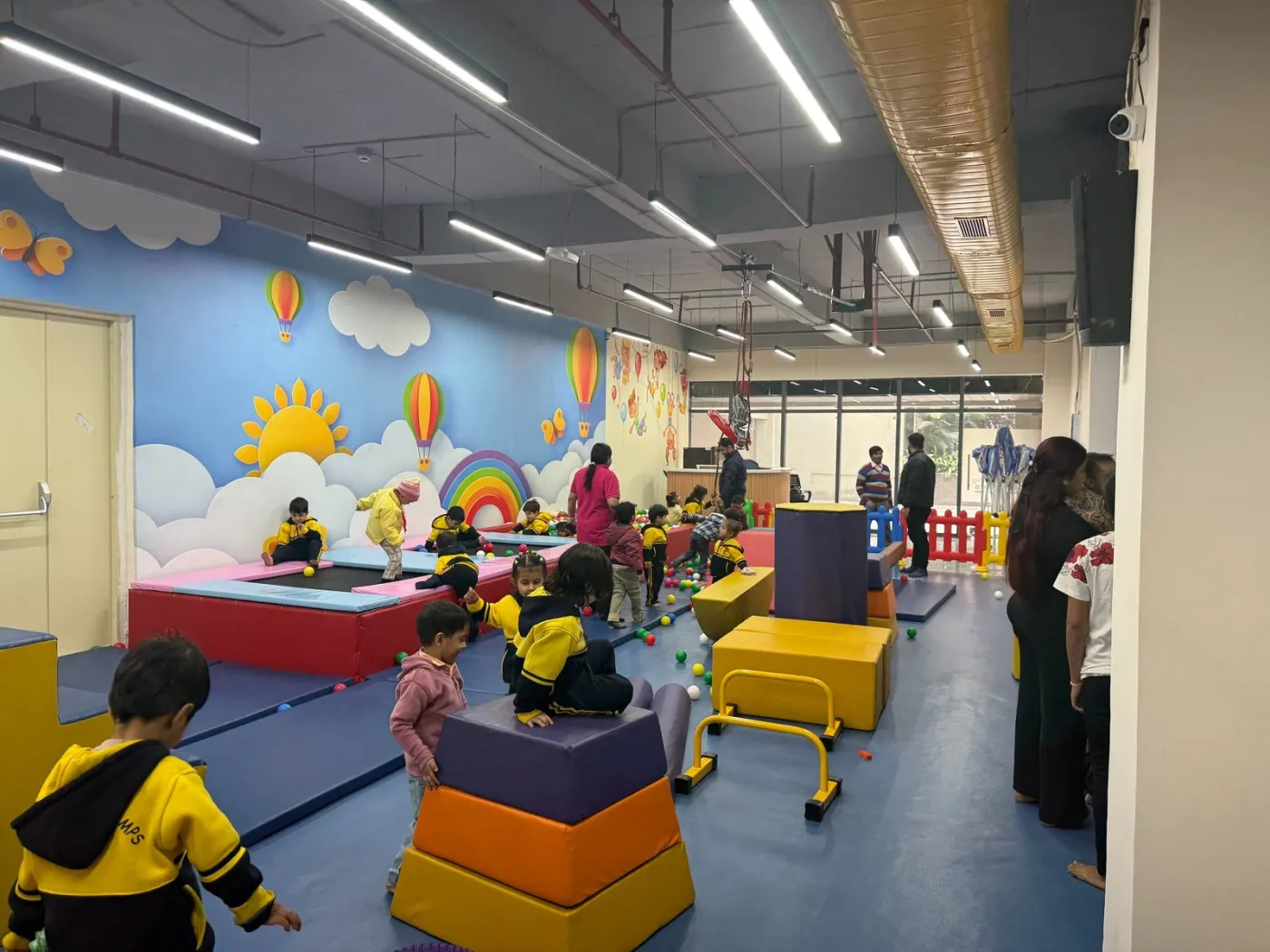
School may cover one of those. Free play may cover another. The gap is usually strength, coordination and body awareness — which is precisely what a structured gymnastics session is built around. WHO's guidance reflects the same idea: it asks for muscle- and bone-strengthening activity, not simply more running about.
Coordination has two halves worth knowing about: the large movements of running, jumping and climbing, and the small, precise movements of the hands. Our guide to gross and fine motor skills explains the difference between the two. In our Centre Programme, every 75-minute class moves from a warm-up into a themed activity of gymnastics drills, obstacle work and a craft task, so both halves get a turn.
Will a weekly class make my child more active?
A weekly class can make a child more active overall, because the skills and confidence it builds make them more likely to choose movement on the days in between.
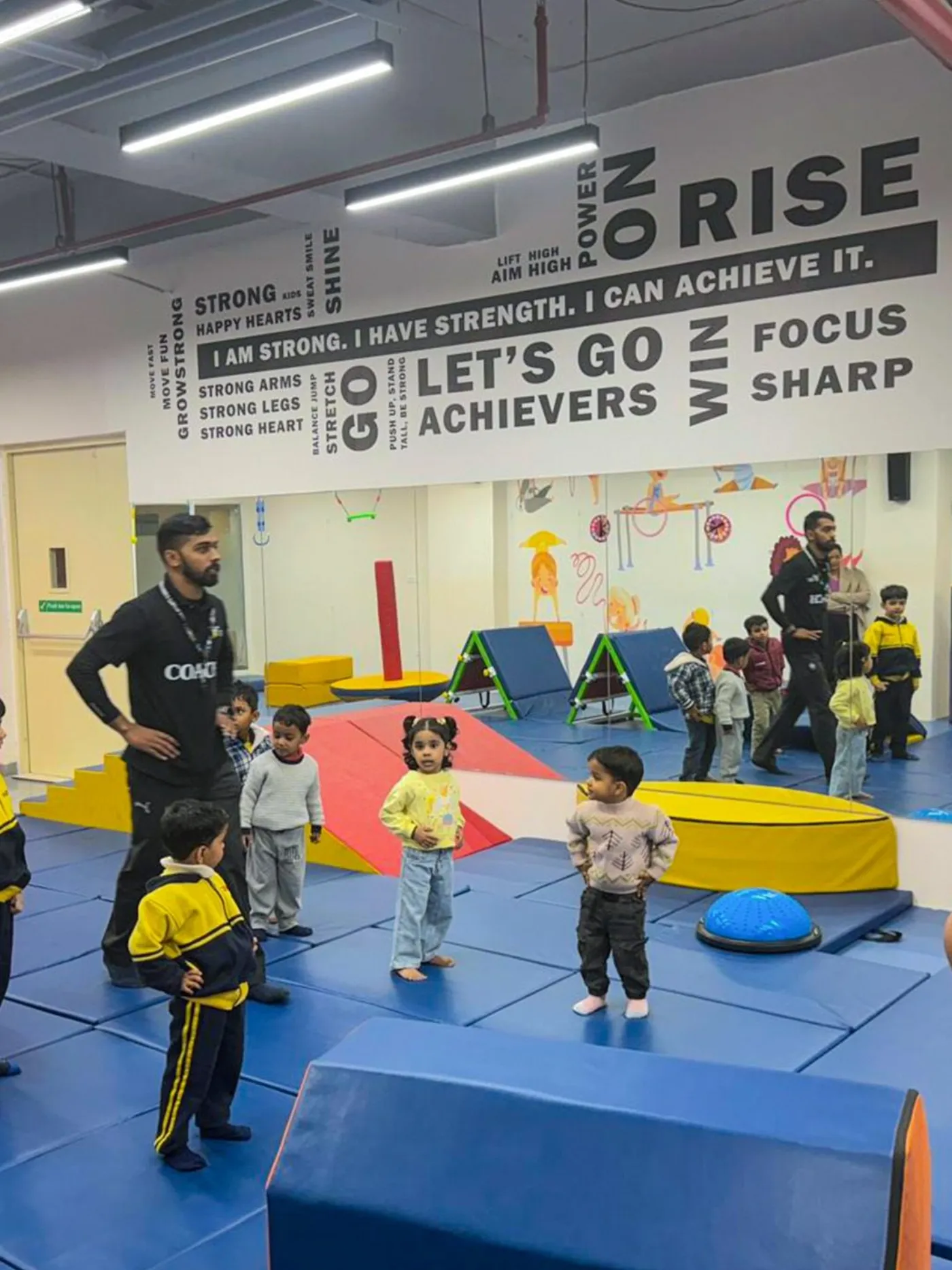
Parents sometimes dismiss a weekly class as a token. In our experience it is the opposite: a single consistent, properly structured 75-minute session, attended across a term, changes more than three sporadic bursts of activity. A child who has learned to land a jump or hold a balance in class tends to try it again in the park at the weekend.
A weekly class will not cover WHO's daily hour on its own, and it is not meant to. Whether once a week suits your child, or a second session would help, depends on their age and the rest of their week — our guide on how many times a week a child should do gymnastics goes through that question properly.
How can I get my child moving more?
The most reliable way to get your child moving more is to attach movement to things that already happen every day, so it does not depend on anyone remembering.
- Walk or cycle the short trips. The school gate, tuition, the shop near the society gate — whatever is close enough and safe enough.
- Make screens come second. Something active first, then the device, is easier to hold than a time limit. There is more on making that stick in our article on screen time and active play.
- Plan for bad-air weeks. In the NCR, pollution can rule out outdoor play for days at a time in winter, so have an indoor routine ready; our guide to outdoor play during pollution sets out what each AQI band means for children.
- Join in. A family walk, a game of catch in the corridor or a race to the lift lobby turns movement into time together rather than a chore.
- Book something fixed. A weekly class at a set time removes the daily decision. If you are unsure where your child sits, book a free trial and ask the coaches directly — they watch children move for a living and will tell you honestly.
Sources
- Every move counts towards better health – says WHO — World Health Organization, 2020
- World Health Organization 2020 guidelines on physical activity and sedentary behaviour — British Journal of Sports Medicine, 2020
- To grow up healthy, children need to sit less and play more — World Health Organization, 2019
- Physical activity fact sheet — World Health Organization, 2024
- Physical activity guidelines for children and young people — NHS, 2024
Questions parents ask
Does walking or cycling to school count as exercise?
Walking or cycling to school counts as physical activity, and the NHS includes walking to school among its examples of activity for children. A brisk walk of ten minutes each way adds a useful chunk to the day. Where distance or traffic make it impractical, a walk or cycle around the society on days the AQI allows can do a similar job.
My child is a healthy weight. Do they still need regular exercise?
Every child needs regular exercise whatever their weight, because activity does far more than manage body fat. WHO links physical activity in children and adolescents with better fitness, heart and metabolic health, bone health, cognitive outcomes and mental health. A slim child who rarely moves can still be weak or unsteady, so judge by what your child's body can do rather than how it looks.
If my child is tired after school, have they been active enough?
Tiredness after school is not a reliable sign of activity, because a long day of sitting, concentrating and travelling can leave a child just as drained as running about. A child can seem exhausted at four o'clock and still have barely moved since the morning. A rough log of one ordinary week, counting the minutes that left them breathing harder, is a far better guide than how tired they look.
Can my child be active enough and still sit too much?
A child can meet the daily activity target and still sit too much, which is why WHO treats the two as separate recommendations. Alongside an average of 60 minutes of moderate-to-vigorous activity a day, its guidelines for 5- to 17-year-olds ask for less time spent sitting, especially on recreational screens. The NHS suggests breaking up long periods of not moving with some activity, which can be as simple as a few minutes of movement between homework subjects.
Does gymnastics count as muscle- and bone-strengthening activity?
Gymnastics counts as muscle- and bone-strengthening activity, and the NHS lists it, along with jumping, among its examples for children and young people. Hanging, climbing, landing from jumps and holding body shapes all ask muscles and bones to work against the child's own body weight. That is the kind of activity WHO's guidance asks children to include alongside running about, and it is easy to miss with PE and park time alone.