
Outdoor play in pollution season: a guide for NCR parents
From mid-October, many NCR parents are caught between two worries: is it fair to keep a child in for weeks, and is it safe to let them out? The honest answer sits between the two, and it changes with the day's reading.
Short answer: Outdoor play is fine when the AQI is Good, and it should get shorter and gentler as the reading climbs. India's health ministry counts children among the groups most at risk from polluted air, and advises them to avoid outdoor physical activity once the AQI reaches Poor (201 and above) and to stay indoors with activity kept low on Very Poor and Severe days.
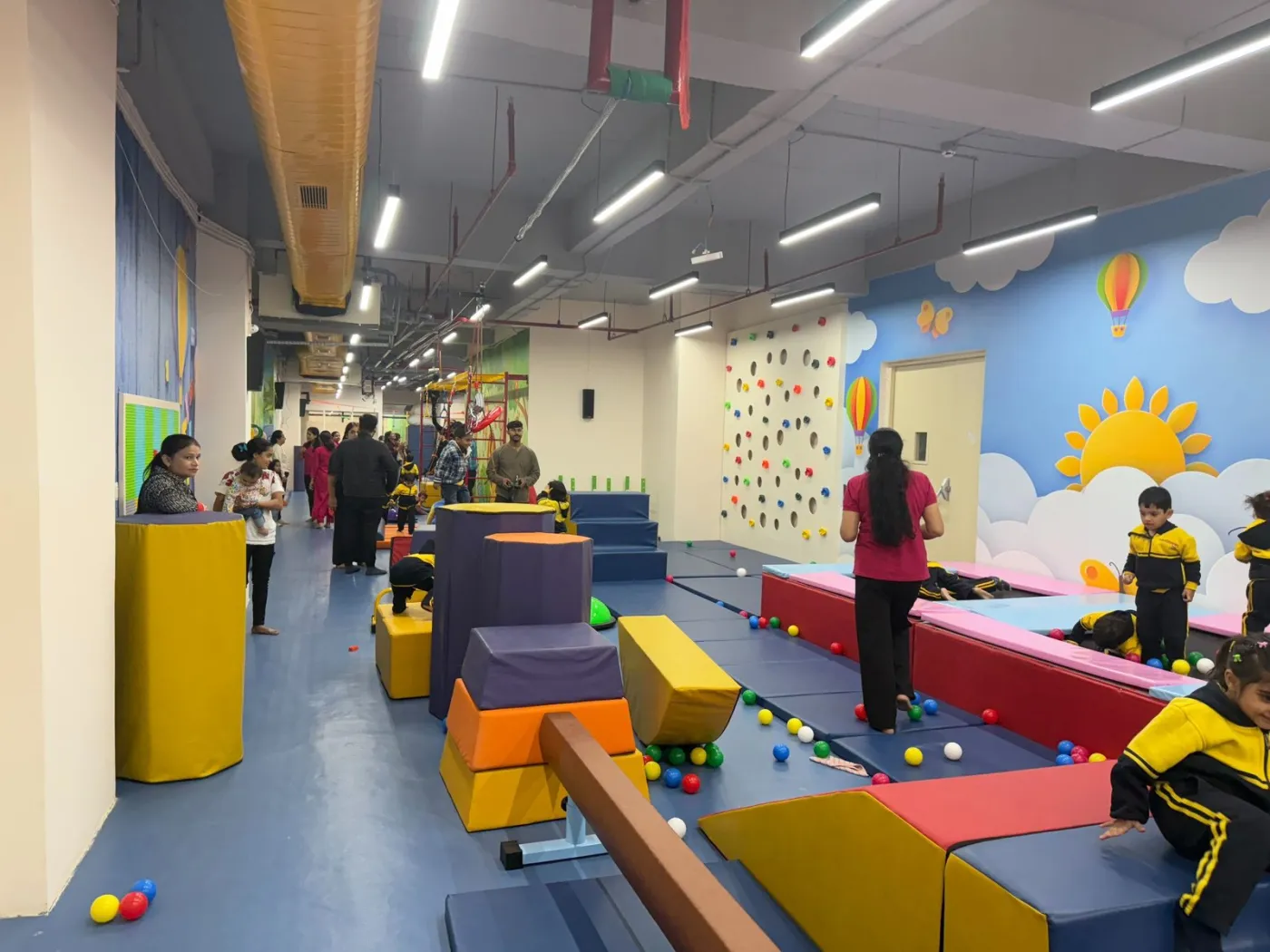
Should kids play outside during pollution?
Children can and should keep playing outside through the pollution season on the days the AQI allows it, because a whole winter of sitting still does them no favours either.
What changes is how you decide. Children take in more air for their body weight than adults, often breathe through their mouths, and breathe faster the harder they play, so a long football game on a Moderate day means a bigger dose than the walk to the school bus. That is why official advice is about how hard and how long children exert themselves outdoors, not just whether they go out.
A child's need to move does not shrink in November; our guide to whether your child is active enough sets out the daily targets.
What AQI level is safe for children to play outside?
No single AQI number makes outdoor play safe for every child, but India's official scale and the health ministry's advice give a clear pattern to follow.
The Central Pollution Control Board (CPCB) reports air quality in six bands, each with a short health note, and the Ministry of Health and Family Welfare's advisory on air pollution pairs each band with advice for vulnerable groups, which it says include children, particularly those under five.
| AQI band | CPCB health note | Advice for vulnerable groups, including children |
|---|---|---|
| Good (0–50) | Minimal impact | No special precautions |
| Satisfactory (51–100) | Minor breathing discomfort to sensitive people | Do less prolonged or strenuous outdoor exertion |
| Moderate (101–200) | Breathing discomfort to people with lung disease, asthma or heart disease | Avoid prolonged or strenuous outdoor exertion |
| Poor (201–300) | Breathing discomfort to most people on prolonged exposure | Avoid outdoor physical activity |
| Very Poor (301–400) | Respiratory illness on prolonged exposure | Stay indoors and keep activity levels low |
| Severe (401–500) | Affects healthy people; seriously affects those with existing disease | Stay indoors and keep activity levels low |
Read down the right-hand column and the pattern is plain. Good means play as normal. Satisfactory means less long or strenuous exertion outdoors, and Moderate means none of it: outdoor time can still happen, but as a cycle round the society rather than an hour of cricket. CPCB's original AQI report also names children and older adults in the Moderate band, alongside people with asthma and heart disease.
From Poor upwards the advice changes from “less” to “not outdoors”. The health ministry's training manual on children and air pollution says plainly that children should not go out to play anywhere from Poor to Severe. Go by your own area's reading for the current hour, not yesterday's city average.
What did CAQM's advisory on school sports say?
The Commission for Air Quality Management (CAQM) has advised that schools across the NCR should not schedule physical sports activities or competitions in November and December, because of the air quality those two months usually bring.
The advisory, dated 10 September 2026, went to the Delhi government and the NCR state governments and repeats a position the commission first took in November 2025. It follows concern from the Supreme Court about children competing in school sports events in poor and severe air. Competitions already fixed for those months may be rescheduled, and students who miss out should not be unduly disadvantaged; the commission suggests offering similar opportunities at a more suitable time.
The advisory is aimed at school sport, but its thinking — keep children's hardest exertion away from the months when poor and severe air is most likely — is just as sensible at home and anywhere else children are active. If your child's sports day moves to a later date this year, this is why.
When does the pollution season usually start in Noida?
In each of the last two years, the NCR's pollution season has effectively begun in mid-October, when the first stage of the Graded Response Action Plan (GRAP) was invoked.
GRAP is the region's set of anti-pollution measures, stepped up as air quality worsens, and it applies across the whole NCR, Noida and Greater Noida West included. In 2024, CAQM invoked Stage I on 15 October after the AQI in Delhi reached 234, in the Poor band. In 2025 it came a day earlier, on 14 October, as air quality deteriorated.
Why mid-October? The health ministry's material for schools explains that in north India, winter weather combines with agricultural burning to pollute the air. It is careful to add that air can be poor in other months too, so the checking habit is worth keeping all year.
This year, readings were already Moderate at the start of October. CPCB's bulletin for 4 pm on 1 October 2026 put Noida's 24-hour average at 194 and Greater Noida's at 116, a reminder that neighbouring cities can sit far apart on the same day. Expect November and December, the months CAQM singled out, to be the hardest.
How can I keep my child active indoors on high-AQI days?
The easiest way to keep a child active indoors is to build short bursts of play into the day at home, rather than waiting for one long session that never quite happens.
A corridor, a few cushions and ten minutes are enough for one burst. Some ideas that work in a flat:
- Simon says, with movement. Every instruction is an action — star jumps, hops, frog leaps — so younger children practise listening as they move.
- A living-room obstacle course. Under the table, over a line of sofa cushions, round a chair and through a bedsheet tunnel. Let your child redesign the route each day.
- Freeze dance. Dance until the music stops, then hold a shape — a star, a tuck, one leg — until it starts again.
- A stretching treasure hunt. Hide small toys high and low around the flat, so finding them means crawling, squatting, reaching and stretching.
- A mini circuit for older children. Ten squats, ten star jumps and a 20-second plank, repeated three times against the clock so they can beat their own record.
- Animal poses. Cat, cobra, tree and frog, each held for a slow count of ten. This is the gentle option.
For balance games such as a masking-tape beam, see the list in our guide to gross and fine motor skills.
Match the effort to the reading. On Moderate and Poor days, play can be as lively as the neighbours downstairs will allow. On Very Poor and Severe days, the health ministry's advice for vulnerable groups is to keep activity levels low, so choose animal poses, slow stretching and holding shapes.
A run of bad-air days can also turn an occasional cartoon into the default; our piece on screen time and active play has ways to stop that.
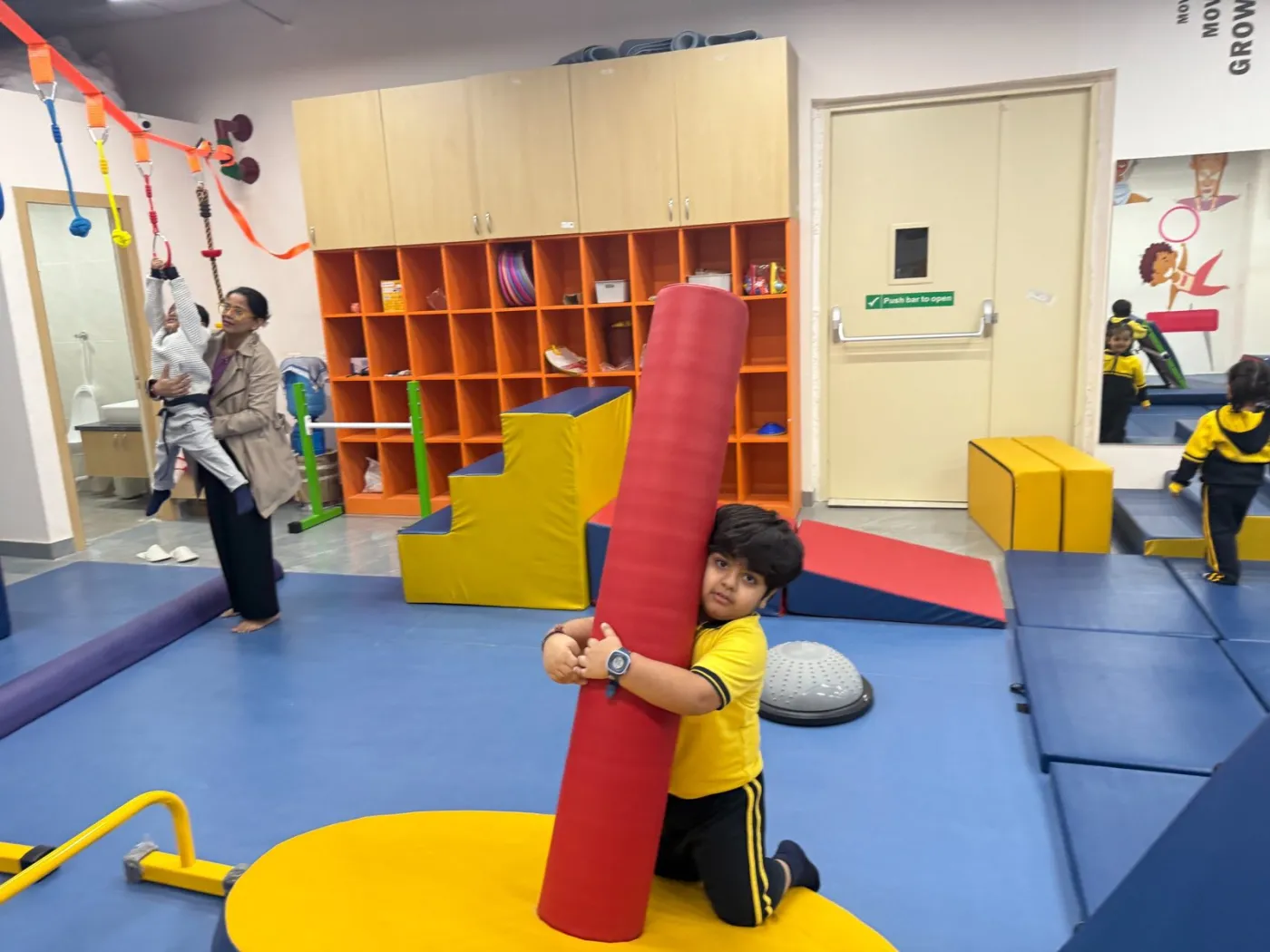
A coached class is one more indoor option if you want a fixed active slot in the week. GrowStrong Achievers runs 75-minute classes for ages 2 to 12 at Golden-I Mall in Techzone 4, within easy reach of families in Gaur City, Sector 16B and Nirala Estate. The age bands and class structure are on the programme page, and you can book a free trial class and watch one first. Treat it like any other outing: getting there means time outside, so the day's AQI and your child's health still decide whether you go — and on Very Poor and Severe days, the advice to keep activity levels low applies to a class as much as to the park.
How can I protect my child from air pollution?
You protect a child from air pollution mostly by checking the reading every day, timing outdoor play sensibly and cutting hard exertion when the air is bad.
- Check before you plan. Look at your area's AQI before deciding on the park, the cycle ride or the walk to tuition.
- Skip early mornings and late evenings on bad days. When the AQI is Poor or worse, the health ministry's advisory says to avoid outdoor exercise at those times.
- Keep play away from traffic and building sites. The advisory lists roads with slow, heavy traffic and construction sites among the places to avoid.
- Reschedule rather than cancel. Move the football or the park visit to a cleaner day instead of dropping it.
- Watch for symptoms. Coughing, breathlessness, wheezing, chest discomfort, giddiness, or red and watery eyes are all reasons to see a doctor. Children are often slow to recognise or mention these, so it falls to you to notice.
- Ask before buying a mask. The advisory says only properly fitted N95 or N99 masks help, and that cloth, paper masks, handkerchiefs and scarves are not effective. Whether one suits your child, and in what size, is a question for your paediatrician.
All of this is general information rather than medical advice. Your child's paediatrician knows their history and is the right person to ask about your own child's limits this winter.
Should a child with asthma exercise during pollution season?
A child with asthma should exercise during the pollution season only within a plan their own paediatrician has agreed, because what is sensible depends on the individual child.
The official guidance does make clear that asthma raises the stakes earlier. CPCB's health note names asthma from the Moderate band (101–200), one band before the point where it expects most people to feel discomfort. The health ministry's advisory asks people with chronic lung conditions to avoid strenuous activity and stay indoors when the AQI is high, keep prescribed medicines to hand, keep a check on their symptoms and seek medical advice quickly if those symptoms get worse. It also singles out fire-cracker smoke as a particular risk for people with asthma, which matters around Diwali.
The useful step now, before the worst weeks, is a conversation with your child's doctor: what activity is fine on which kind of day, what to do if symptoms start mid-play, and whether their plan changes for winter. Then share the answers with everyone who supervises your child's activity — school, grandparents and any coach.
Sources
- National Air Quality Index (CUPS/82/2014-15) — Central Pollution Control Board, 2014–15
- Air Quality Index bulletin, 1 October 2026, 4 PM — Central Pollution Control Board, 2026
- Health Advisory on Air Pollution — National Centre for Disease Control, Ministry of Health and Family Welfare, 2022
- Air Pollution and its Impact on Children’s Health: training manual — National Centre for Disease Control, Ministry of Health and Family Welfare, 2022
- No physical sports in Delhi-NCR in Nov-Dec? Here’s what CAQM said — Business Standard, 2026
- Delhi records poor air quality; Govt imposes GRAP Stage 1 in NCR — Akashvani News, 2024
- Delhi-NCR implements GRAP Stage-I to tackle worsening air quality — Akashvani News, 2025
Questions parents ask
Where can I check the AQI for my area in Greater Noida West?
The quickest way to check your local AQI is CPCB's Sameer app, which the health ministry's advisory points to for hourly city-level readings. CPCB's daily bulletin lists Noida and Greater Noida as separate cities, and their readings can be quite different, so families in Greater Noida West may want to glance at both. Check on the day itself, just before you head out, because the figure changes through the day.
Is there a better time of day for outdoor play in winter?
The middle of the day is usually the better time for outdoor play in winter, because the health ministry's manual on children and air pollution describes noon to 4 pm as the hours when air quality is relatively better. On bad-air days it also advises against outdoor walks, runs and exercise in the early morning and late evening. The reading on the day still matters more than any rule of thumb.
Is indoor play as good for my child as playing outside?
Indoor play can cover most of what a young child's body needs, including balance, strength, coordination and climbing. What it rarely offers is room for long sprints, ball games and the unplanned rough-and-tumble of a society park, so treat indoor weeks as a stopgap and head back outside when the reading allows. Through the winter, the real aim is to stop movement disappearing from the day.
How do I explain to a young child why they cannot go out to play?
Explain it in one short sentence and use the same words every time, such as: the air outside is dirty today, so we are playing inside. Showing a child the colour on the AQI app can help them see that the decision comes from the number rather than from you, and older children often like checking it themselves. Offer the indoor plan straight away, so it feels like a change of game rather than a lost afternoon.
Are toddlers more affected by polluted air than older children?
Children under five are the age group the health ministry's advisory singles out as particularly vulnerable to air pollution, so toddlers deserve the most caution. A toddler also cannot tell you that their chest feels tight or their throat is sore, which means watching for coughing, wheezing, breathlessness or red, watery eyes yourself. If you notice any of these on high-AQI days, talk to your paediatrician rather than waiting to see whether they pass.
What should I do if my child's school cancels outdoor sport this winter?
If school sport is cancelled or postponed, plan to replace that movement at home rather than assuming it will be made up later. A games period is often one of the few times in a school week when a child properly works up a sweat, so give its place to something fixed: a short indoor routine after homework, active weekend play when the AQI allows, or a regular class. Our guide on whether a child is active enough explains what to aim for.