What age should a child start gymnastics?
The honest answer is that almost any age works, provided the session is built for that age. The mistake is not starting too early or too late. It is putting a child in a class designed for someone else.
Short answer: A child can start gymnastics from about two, as long as the class is built for their age: play-based rolling, climbing and balancing for toddlers, with named skills taught properly from around six. For recreational gymnastics there is no age at which it becomes too late. A child starting at nine or eleven simply joins a group designed for their stage.
What is the best age to start gymnastics?
Any age from about two is a good age to start gymnastics, provided the class is designed for your child's stage of development. Parents usually ask because they are worried about one of two things: that a toddler is too small to do anything useful, or that a nine-year-old has somehow missed the boat. Neither is true.
What is true is that a two-year-old and a nine-year-old need almost nothing in common from a gym, and a class that tries to serve both will fail at least one of them. That is why our Centre Programme runs five separate age bands between two and twelve, rather than one class for everyone.
Paediatric advice points the same way. The American Academy of Pediatrics' guidance for parents says that before about six, most children do not yet have the basic motor skills for organised sport, and suggests activities built on basics such as running, tumbling, throwing and catching. It lists gymnastics among the activities that suit six-to-nine-year-olds, by which age most children can manage simple organised sport. Early gymnastics, in other words, should look and feel like play.
Where do toddlers fit in?
Toddlers fit in from about two, as long as the class is a gentle introduction through play rather than training. Nothing is drilled at this age. Toddlers explore movement by rolling, hanging, climbing on and off things and learning to fall over safely, on soft-play and low apparatus only.
Underneath the play, basic patterns are being laid down: balance, changing direction, judging distance. For many children it is also the first time an adult who is not a parent gives them instructions in a group, which is a skill of its own. That is the job of our Little Explorers band, for ages two to four, where there is no pressure to perform. Toddlers raise enough questions of their own to need a separate guide to classes for 2-year-olds.
What do 4 to 6 year olds learn in gymnastics?
Four-to-six-year-olds learn the movement basics that school will soon ask of them: balance, jumping and landing, and following a two-step instruction. This is the age when you start seeing change you can point at. Playful exercises and games build real coordination and strength, and children learn to hold a shape on request and to wait for their turn in a group.
It is also a useful window for fine motor work. Grip, precision and hand–eye coordination are developing quickly, and they show up a little later in how comfortably a child holds a pencil. The craft task in each class is there partly for that reason, and our piece on gross and fine motor skills explains why the two belong in the same hour. At GrowStrong this stage is the Mini Champs band.
When do children start learning real gymnastics skills?
Children can start learning named gymnastics skills properly at around six, when most can understand a shape, practise it and remember it the following week. That progression is the point. For many children it is the first direct experience of effort producing improvement, a lesson that travels well beyond a gym.
Between six and eight, partner tasks and small-group challenges also start doing real social work, and teamwork stops being a word and becomes something children feel. In our Skill Builders band, named gymnastic shapes, partner work and teamwork make up the core of the hour.
Is it too late to start gymnastics at 8, 10 or 12?
It is not too late to start gymnastics at eight, ten or twelve; an older beginner simply starts in a band built for their age, with different drills and a different pace. Older beginners often pick up the basics quickly, because they bring more strength, a longer attention span and an understanding of why a drill matters. If you are reading this with a nine-year-old in mind, the honest answer to when they should start is now.
From eight to ten, our Confident Creators band works on longer skill sequences and on core and upper-body strength. From ten to twelve, Future Achievers adds conditioning that respects growing bodies and moments of leadership within the group. If you are wondering whether training at this age affects growth, we have looked at what the research says about gymnastics and height.
These are also the years most worth protecting. Screens compete harder, school gets busier, and a child who decided at six that they were “not sporty” now has the words to opt out. A class that fits them can keep a ten-year-old moving at the age many children start to drift away from activity.
Does a child need to start young to be good at gymnastics?
A child does not need to start young to enjoy gymnastics, get stronger or become skilful at it; an early start mainly matters for the few aiming at elite competition. The American Academy of Pediatrics notes that gymnastics is one of a handful of sports that may require early specialisation, because performance peaks before the body has fully matured.
For everyone else, the same AAP report points the other way. It says the main aim of sport for young athletes should be to have fun and learn lifelong physical-activity skills, and that playing more than one sport, at least until puberty, lowers the chances of injury, stress and burnout. A child who starts at nine, enjoys it and keeps going is getting exactly what that advice describes.
So the useful question is not how early, but how well the class fits, and our guide to choosing a kids' gym shows how to judge that from a trial.
What should a child learn first in gymnastics?
A child should first learn how to land, fall and roll safely, then basic body shapes, balance and taking weight on their hands. Every later skill is built on these unglamorous foundations, and they keep children safe as skills get bigger. The American Academy of Pediatrics' gymnastics safety advice counts proper landing technique, a good warm-up and step-by-step skill progression among the ways to reduce injury.
In a well-run class, the order looks something like this:
- Landing and falling. Two feet, soft knees, and rolling out of a fall instead of throwing out a straight arm.
- Body shapes. Tuck, star, straddle and a straight, tight body, each held for a few seconds on request.
- Balance. Standing on one foot, walking a line, then a low beam.
- Hanging and climbing. Grip and upper-body strength, which many children find harder than running and jumping.
- Rolling and weight on hands. Rocking, rolling and bear walks before anything goes upside down.
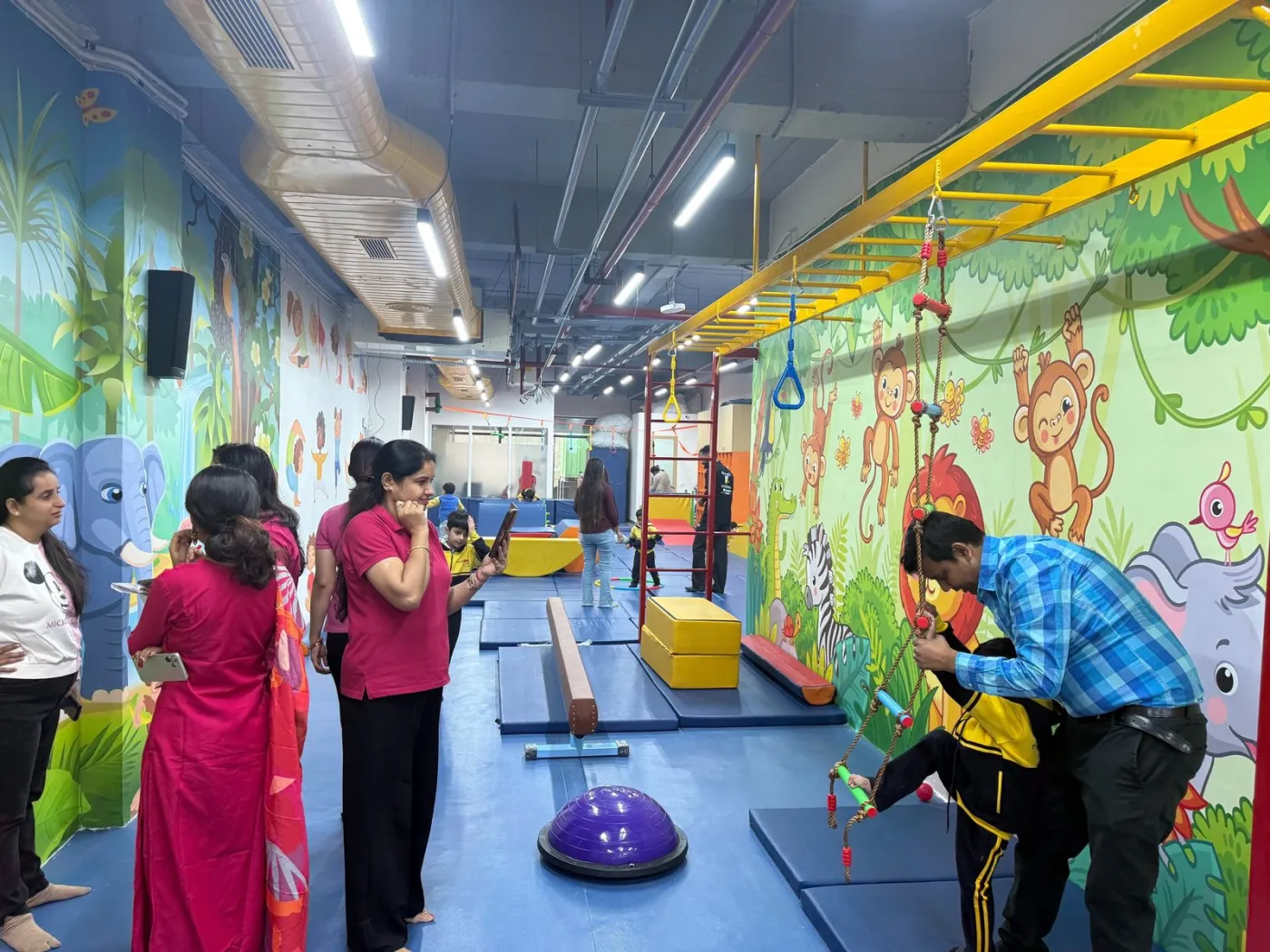
Cartwheels and handstands come after these, not instead of them. A class that rushes to tricks before landings is skipping the part that matters most.
How do I know if my child is ready to start gymnastics?
Your child is ready to start gymnastics when they can cope with a short time in a group led by a coach, whatever their age and however sporty they seem. They do not need to arrive strong or confident on equipment; building those is what the class is for. A few signs worth noticing:
- They can manage a little time away from your side, as long as you are in sight
- They can follow a simple instruction, at least some of the time
- They are curious about climbing, jumping or rolling
- They can play actively for an hour or so without needing a nap halfway through
Children develop at very different rates, and none of this is a test. If you have a concern about how your own child moves or is developing, your paediatrician is the right person to ask. Otherwise, the simplest way to find out is to book a free trial class and let a coach watch your child move.
Once they have started, how often to come is a separate decision, covered in our guide to how many times a week a child should do gymnastics.
Sources
- Is Your Child Ready for Sports? — American Academy of Pediatrics (HealthyChildren.org), 2024
- Sports Specialization and Intensive Training in Young Athletes — American Academy of Pediatrics clinical report, Pediatrics, 2016
- Gymnastics: Keeping the Sport Safe & Fun for Kids — American Academy of Pediatrics (HealthyChildren.org), 2024
Questions parents ask
My child is not flexible. Can they still do gymnastics?
A child who is not flexible can still do gymnastics, because flexibility is something the classes build gradually. Young children are often more supple than they will be later, and older beginners improve with regular stretching once they are warmed up. What matters at the start is a willingness to have a go. Nobody should ever push a child into a stretch that hurts.
Should we wait until our child asks to do gymnastics?
You do not need to wait for your child to ask, because many young children do not know gymnastics is an option until they try it. Interest usually follows experience rather than coming before it. A free trial lets them find out what it involves without any commitment, and their reaction afterwards will tell you more than asking them in advance.
Will my child be pushed too hard in gymnastics?
A well-run class will not push a young child too hard, because gymnastics for under-sixes should be mostly play: rolling, climbing, balancing and short, varied turns. Intensity should rise gradually with age and skill. Long hours of repetitive training belong to competitive squads, not to a weekly class for young children. If a session for a small child looks like drilling, or tears are brushed aside, that is a reason to look elsewhere.
Is gymnastics just as suitable for boys?
Gymnastics is just as suitable for boys as for girls, and boys can start at exactly the same age. The early years look the same for both: rolling, balancing, jumping, landing and climbing. Men's and women's competitive gymnastics use different apparatus later on, but that only matters for children who go on to compete. The strength and body control it builds are equally useful to both.