How to choose a kids' gym: what to watch and what to ask
Most children's activity centres photograph well. Photographs will not tell you whether the sessions are structured, whether the coaching progresses, or whether your child will still be going in month four. A real class and a few direct questions will.
Short answer: Choose a kids' gym by watching a real class with your child in it, not by touring an empty room. Look for coaches who teach rather than just supervise, children grouped by age, a session with a clear plan, and effort recognised as readily as ability. Then check the practical details and ask your child whether they want to go back.
Is it a gym, or a play area with equipment?
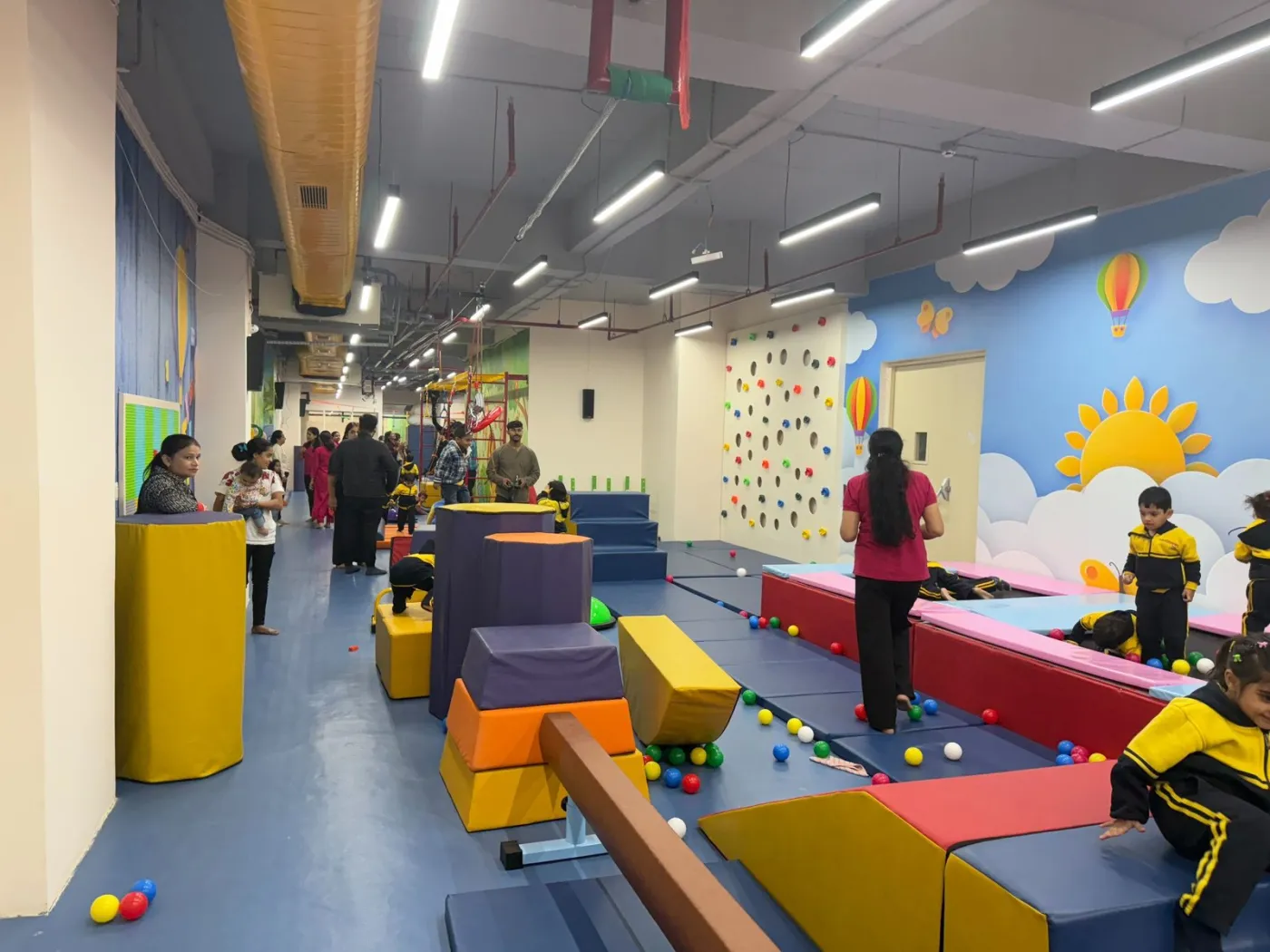
A kids' gym runs coached sessions with a plan, while a play area supervises children as they do whatever they like. This is the biggest difference between centres and the least advertised. In a gym, a coach runs a session with a beginning, a middle and an end, and takes the children somewhere specific.
Both have their place, and a play area is a perfectly good way to spend a wet afternoon. Only one is designed to build skills week on week. Ask directly: is there a session plan, and who wrote it?
Are the children grouped by age?
A well-run kids' gym splits children into genuine age bands, so a four-year-old is not learning alongside a nine-year-old. “Ages 3 to 12 welcome” on a single timetable can mean one mixed class, so ask how many separate bands run and what the age spread is inside each.
A four-year-old and a nine-year-old need different drills, instructions and pace, so a mixed session ends up too hard for one or too dull for the other. Our guide to what gymnastics looks like at each age shows how much changes between two and twelve.
A centre that watches your child move before placing them, rather than going by birthday alone, is usually taking its banding seriously.
What does a good kids' gym class look like?
A good kids' gym class follows a clear, predictable shape, so children know what comes next and spend the hour moving rather than waiting. There is no single correct format, but strong sessions share a few things: a proper warm-up before anything demanding, a main activity that builds on last week, short turns instead of long queues, and a calm finish.
As one example, every 75-minute class at GrowStrong runs through the same five stages in the same order:
- Affirmations — each child names something they are good at.
- Social greetings — a hello circle, so every child is spoken to by name early on.
- Warm-up — to get bodies ready before any apparatus comes out.
- Themed activity — gymnastics drills, obstacle work and a craft task built around the week's theme.
- Award moment — recognition for effort and improvement, not for winning.
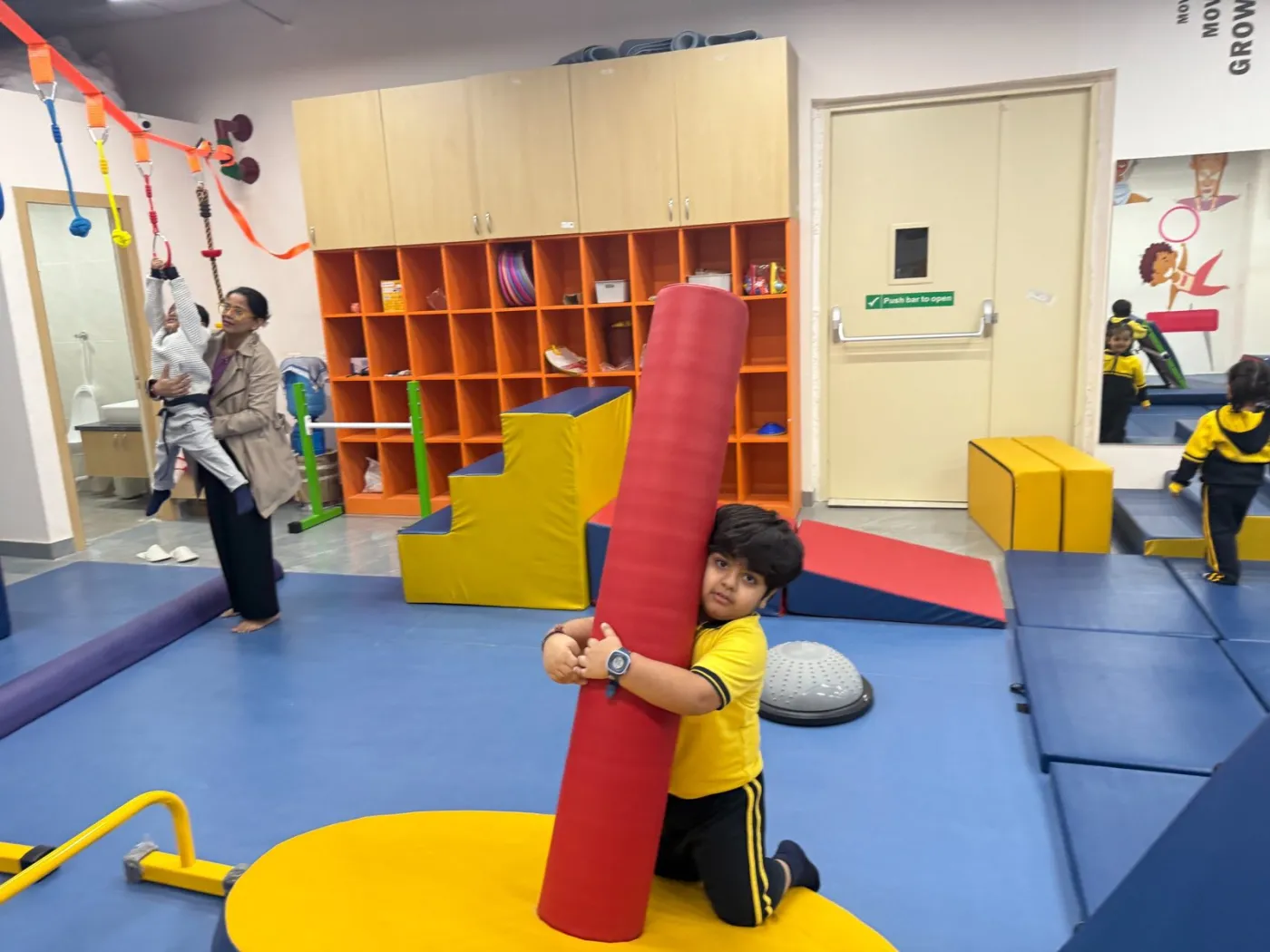
Other centres organise their hour differently, and that is fine. What matters is that a structure exists, the coach can explain it, and it was designed for children of your child's age rather than scaled down from an adult class.
Behind the hour there should be a curriculum built against something published, such as the CDC's developmental milestones or the Indian Academy of Pediatrics guidelines. A centre that maps its sessions to them can tell you why a five-year-old does what they do. Ours is aligned to both, and the Centre Programme page sets out what each age band works on. If the answer to “what is this based on?” is a shrug, the sessions may be fun, but they are not developmental.
What should I look for in a trial class?
In a trial class, look at how much of the hour your child spends moving and being taught, rather than at how well they perform. An empty room tells you about the flooring and nothing about the coaching, so ask to see a class actually running, ideally with your own child in it. A centre confident in its sessions will offer this, often as a free trial.
While you watch, notice:
- How much of the hour the coach spends teaching, and how much children spend waiting in line
- Whether the coach uses children's names and notices the quiet ones, not only the confident ones
- What happens when a child cannot do something: are they helped into an easier version, or left at the back?
- Whether recognition at the end goes to effort and improvement, or only to the most able
The handling of failure is the detail to weigh most. It predicts whether your child will still be attending in three months far better than any piece of equipment. Our walkthrough of what happens in a first gymnastics class describes the trial from your child's side.
What questions should I ask the coach?
Ask the coach questions that show how sessions are planned and how your child will be looked after, and expect quick, specific answers. A vague reply is an answer in itself.
- What will my child work on this term, and how will I know they are progressing?
- How do you adapt a drill for a child who finds it too hard, or too easy?
- What do you do when a child is nervous, upset or refuses to take part?
- How do you keep children interested once the novelty wears off?
Good coaches are glad to be asked. If your child is slow to settle in new groups, say so; we have written separately about helping a shy child join in.
How do I know if a kids' gym is safe?
A kids' gym is safe when the coaching, supervision and equipment are all sound, not just the flooring. Padded floors and apparatus sized for children are the minimum, not a selling point. The American Academy of Pediatrics' advice on gymnastics safety asks for more: coaches who understand how children develop at different ages and are certified in CPR and first aid, supervision and spotting at all times, equipment that fits and is kept in good repair, and an emergency plan the team has practised.
You can check most of that by asking: who supervises each part of the session, how many children each coach looks after, and what happens, step by step, if a child is hurt, including whether you are told the same day. The answers should come readily and match what you see on the floor.
If your child has asthma, a heart condition or a recent injury, talk to your child's paediatrician about any precautions before they start, and tell the coach before the first session.
What should I check before joining a kids' gym?
Before joining, check the practical details you will feel every week, because they decide whether you keep going. An excellent session you cannot reach on time in July traffic will do less for your child than a good one ten minutes from home.
- Timings: can you realistically make the slot every week, around school, tuition and traffic?
- Travel time, which is often what makes families give up on an activity
- Parking, and whether it is a scramble at the hour your class runs
- What happens if you miss a week
- Whether siblings of different ages can attend at compatible times
If you can, try the journey once at the time your class would run. Our centres in Greater Noida West and Lucknow are open 9 AM to 8 PM every day, and the contact page has addresses and directions for both centres.
How will I know it is the right gym for my child?
You will know it is the right gym when your child wants to go back, because that wish is what keeps them attending long enough to benefit. After the trial, ask them one question: do you want to go again? Children are unreliable judges of curriculum quality and completely reliable judges of whether they felt capable and noticed.
If the answer is a firm no, find out whether it was the gym or the activity. Some children are simply happier moving to music or in a martial-arts class, and that is worth knowing early. Our guides comparing gymnastics with dance and gymnastics with karate can help you weigh it up.
If the answer is yes, the rest is consistency: pick a slot you can keep, and give it a full term before judging the results. You can book a free trial class at either centre and watch the whole session for yourself.
Sources
- Gymnastics: Keeping the Sport Safe & Fun for Kids — American Academy of Pediatrics (HealthyChildren.org), 2024
Questions parents ask
We are deciding between two centres. How should we compare them?
Compare two centres by trialling both in the same way: at a similar time of day, with the same questions, and with your child taking part each time. Note how long the children spent moving rather than waiting, and whether the coach learned your child's name. Then ask your child which one they would go back to, and give that answer real weight.
Which red flags should make me walk away from a centre?
The clearest red flag is a centre that will show you an empty room but not a class in progress. Others include one mixed group covering a wide age range, children queuing more than they move, prizes only for the most able, pressure to pay before your child has tried a session, and vague answers about what happens if a child gets hurt.
Is more equipment a sign of a better centre?
More equipment is not, on its own, a sign of a better centre, because most of what a child gains comes from the coaching. A few pieces of apparatus used well in a planned session do more than a large room that children simply roam around. Watch whether each piece in use has a clear purpose in the lesson, and whether every child gets regular turns on it.
How much should I trust online reviews?
Trust online reviews for patterns rather than verdicts, because they cannot tell you how your own child will respond to a particular coach or group. Look for points that several families mention, such as how the centre communicates, whether classes start on time and how children are spoken to. Treat any single review, glowing or furious, with caution, then watch a class yourself.
Is it worth talking to parents whose children already attend?
Talking to parents whose children already attend is worth a few minutes, because how long families stay tells you more than any first impression. Ask how long their child has been coming, what has changed for them, how the centre handles a missed class or a worry, and whether their child still looks forward to going. Parents waiting during a class are often glad to talk.