
What actually helps a shy child join in
Every week a child spends the first few minutes of a class behind a parent's leg, and a parent quietly decides this will never work. It usually does. Here is what makes the difference, and what makes it harder.
Short answer: Tell your child what will happen, mention their shyness to the coach privately, arrive a few minutes early and let them watch before they join. Stay calm and where they can see you, keep goodbyes short, and never force or bribe. Holding back in a new group is common, and most shy children relax as the place and the routine become familiar.
How do I help my shy child join a new class?
You help a shy child join a new class by making it predictable before you arrive, and by giving them an unhurried way in once you are there.
- Describe the hour beforehand. Tell your child what will happen, in what order, and where you will sit. The American Academy of Pediatrics (AAP) also suggests role-playing ahead of time: practise a hello at home and the real one feels smaller.
- Tell the coach privately, by phone, WhatsApp or a quiet word at the desk. A coach who knows can keep a gentle eye on your child in the first few minutes, which is often when a hesitant child decides whether to join.
- Arrive with time to spare. Being in the room while it fills up is far easier than walking into one that is already full and loud.
- Let them watch first. Watching a round from the edge is reconnaissance, not failure, and many children step in on the next round unprompted.
- Be the calm, boring part of the room. If you look worried every time they glance over, they will assume there is something to worry about.
- Praise the step. “You stood in the circle today” is worth saying; the AAP advises praising even small steps, because for a shy child they are not small.
Is it normal for a child to refuse to join in?
Refusing to join in at first is a normal response for many young children, particularly somewhere new, among adults and children they have never met. The AAP describes a “slow-to-warm-up” temperament: children who adapt slowly to unfamiliar people and surroundings, tend to hold back when they first meet them, and typically become more accepting once things feel familiar. It also notes that temperament is, for the most part, something a child is born with.
Hesitation usually describes how your child meets the world; it is not a verdict on the class or on your parenting.
Count how much is new at once. A child who has mostly been at home, or has only just started playschool, is being asked to follow a stranger's instructions in a group, on unfamiliar equipment, with other children watching. Holding back for a while is a sensible response.
How can I tell whether my child is shy or anxious?
You can often tell shyness from anxiety by where your child is looking: a shy child watches the other children, while an anxious child watches the door. The two look alike from across the room but need different handling.
A shy child wants to join and needs a way in. Over the session they edge closer, copy a movement from the sidelines, perhaps smile at another child. An anxious child wants the situation to stop. They stay fixed to you, their distress does not ease as the minutes pass, and the activity barely seems to register.
Most hesitation at a first class is the shy kind, and in our experience it often eases within a session or two. If it looks more like anxiety, slow everything down: shorter visits, more watching, no pressure to take part.
Should I push a shy child to take part?
You should not push a shy child to take part, but you should keep offering the chance, calmly and without fuss. Pressure tends to make a hesitant child dig in, while dropping every expectation teaches them that saying no makes the uncomfortable thing go away.
The useful middle ground is a small, specific invitation. “Shall we stand at the edge of the circle?” is easier to accept than “Go on, join in.” If the answer is no, accept it, stay where you are and offer again in ten minutes. The AAP's advice is similar: encourage small steps, such as joining a game for a few minutes.
What you are protecting is your child's sense that they chose to step in. A child carried onto the mat learns that their feelings do not count. A child who walks on after ten minutes of watching learns they can do something that felt hard, which is where confidence in children really comes from.
What should I not do when my child is shy?
The things to avoid when your child is shy are the ones that add pressure or attention just when they are trying to make themselves small.
- Slipping away to “make it easier”. For a child who is already unsure, a parent who vanishes confirms that something bad is happening.
- Long, anxious goodbyes. The opposite mistake: extended reassurance tells a child the situation must need it.
- Bribes. A treat for joining in turns the class into something to be endured for payment.
- Comparisons. “Look, your cousin is doing it” tells a child they are being ranked, which is the very thing they fear.
- Labelling them out loud. “She's very shy”, said in front of her, hands a child an identity to live up to.
- Answering for them. When a coach asks your child's name, let a few seconds of silence pass before you step in. Sometimes the answer comes.
Can a gym class help a shy child?
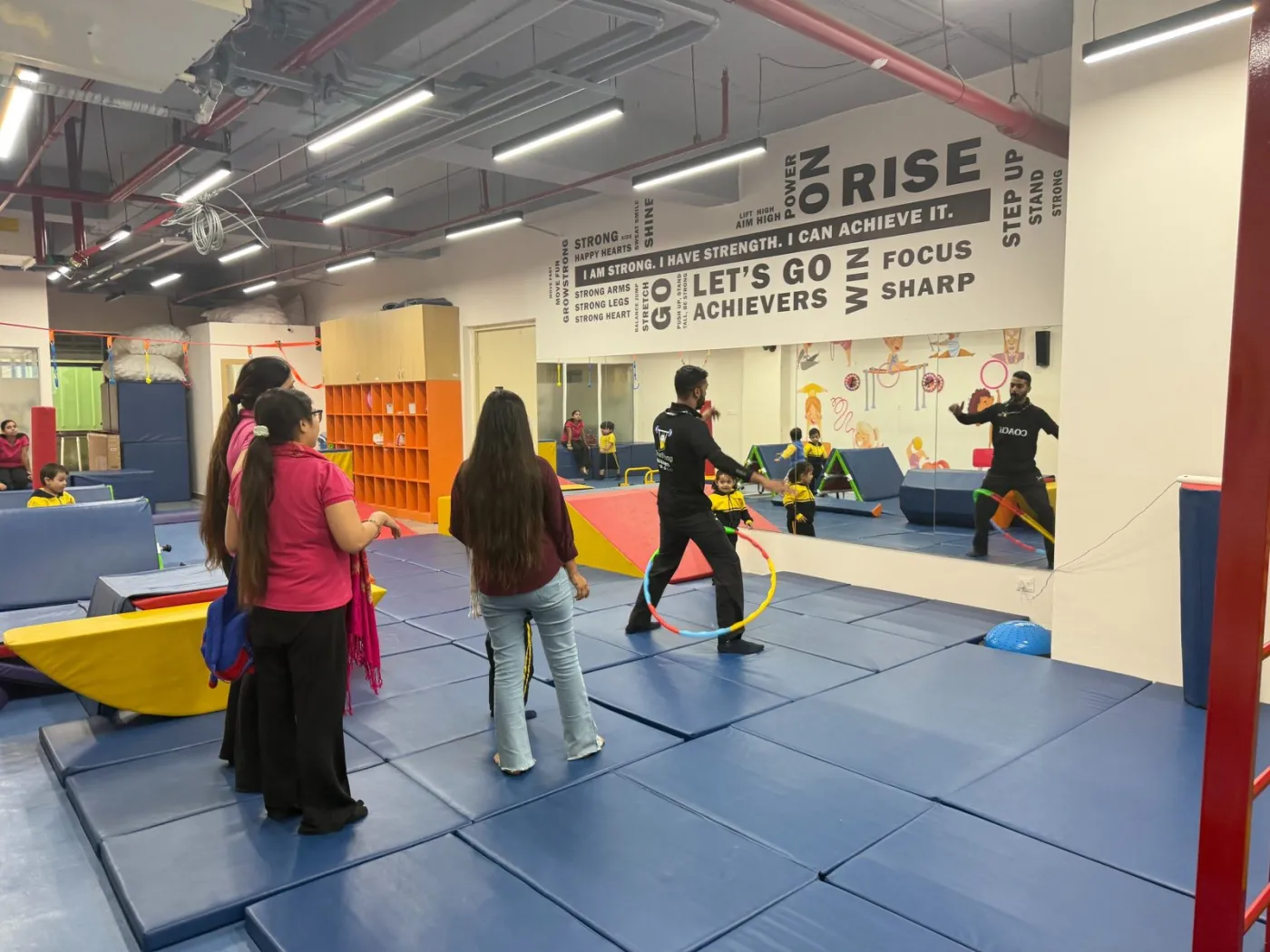
A well-run gym class can help a shy child, because it offers a predictable routine and small, safe ways to take part before anything is asked of them in front of others. Every GrowStrong class follows the same five stages: affirmations, where each child names something they are good at; a hello circle; a warm-up; a themed activity of gymnastics drills, obstacle work and a craft task; and an award moment.
For a hesitant child the first two stages do the most work, offering a scripted, low-risk first contribution before any equipment or performance is involved. Because the order never changes, little is new by the third visit. Our Centre Programme page shows how the hour is built; for the youngest, Little Explorers (ages 2–4) uses only soft-play and low apparatus and never asks a child to perform.
Sessions are also non-competitive, and the award moment celebrates effort and improvement rather than winners. Many shy children dread being compared; take the ranking away and joining in is no longer a public test.
For a very first class, our guide to what to expect at a first gymnastics class walks through the day itself, and if you are also considering a martial art, our comparison of gymnastics and karate for kids may help.

How long does it take a shy child to settle into a class?
In our experience, three sessions is a fair test of whether a shy child will settle into a class, though some are ready sooner and a few need longer.
The first visit is entirely new. The second is familiar but still uncertain. By the third, most children have a face they recognise and a routine they can predict, and the reluctance begins to fall away.
If nothing has shifted by then, tell us. A different time of day or a different band sometimes suits a child better, where your centre can offer it, and we would rather adjust than have you decide your child “is not a group-activity child”.
When should I worry about my child's shyness?
You should talk to your child's paediatrician if things do not seem to be getting better, particularly if your child gets very upset with strangers or at any time away from you, or seems sad or anxious. That is the AAP's advice, and a sensible line to hold.
Shyness on its own is part of temperament, not a problem to fix. What deserves a closer look is distress that is intense, lasts for weeks or starts to affect sleep, eating, school or friendships. A coach can tell you how your child is doing in class, but not why, and that conversation belongs with a doctor who knows your child.
For most families the next step is simpler: book a free trial class, watch the whole session and see how your child responds when nobody hurries them.
Sources
- Understanding Your Child's Temperament: Why It's Important — American Academy of Pediatrics, HealthyChildren.org, 2024
- My daughter is extremely shy and anxious around strangers. How can I help her? — American Academy of Pediatrics, HealthyChildren.org, 2021
Questions parents ask
What should I tell the coach about my shy child?
Tell the coach what helps your child settle and what tends to upset them, so the first few minutes start on the right foot. Useful details include the name your child answers to, whether they warm up by watching or by being given a small job, and any recent change at home or school. Say it privately before the class, not in front of your child.
Will my child grow out of being shy?
Many shy children become far more comfortable with time and practice, though a quieter nature often stays with them, and that is fine. The American Academy of Pediatrics notes that temperament is largely something a child is born with. The realistic goal is not a different personality but a child who has reliable ways into a new group and feels able to use them.
Is shyness the same as low confidence?
Shyness and low confidence are different things, even though they can look alike at the edge of a new class. Shyness is discomfort with new people and attention, while confidence is a child's belief in what they can do. A shy child can be fearless on a climbing frame, and an outgoing child can still doubt their own ability. Each needs a slightly different kind of support.
Does bringing a sibling or friend help a shy child settle?
A familiar face often helps a shy child walk in, so bringing a sibling or friend can make a first visit easier. Bear in mind that coaches place each child in an age band on the day, so the two may end up in different groups. Even then, knowing someone they love is in the building, or watching from the side, can be enough.
Is there a difference between a shy child and an introverted one?
A shy child and an introverted child are not the same, although one child can be both. Shyness is about feeling uneasy around new people or when others are watching. Introversion is about energy: an introverted child may be perfectly comfortable in a group but needs quiet time afterwards to recharge. A child who is happy but worn out after class is not necessarily shy.